
Energy that is too expensive means fewer jobs, less industry and less purchasing power. Europe must change course and rely on abundant, competitive and low-carbon energy to remain an economic power and succeed in its transition. Diversification, nuclear power, simplifying rules and energy sovereignty are the keys to a credible strategy. This is the course we are defending to protect our economy and prepare for the future.
1. Abundant and affordable energy: a priority for the MR and for the reindustrialisation of Europe
The European Union will be unable to preserve its prosperity, achieve carbon neutrality, or defend its sovereignty without a profound shift in energy policy. Energy costs have become a major competitiveness handicap, as highlighted by the Draghi report almost two years ago. With ongoing tensions in Eastern Europe and the Middle East, this handicap has grown further, with European gas remaining persistently more expensive than American gas, oil prices staying high, and European electricity prices weighing more heavily on industry than in other major advanced economies. This situation is accelerating deindustrialisation, weakening purchasing power and slowing decarbonisation, since it becomes more costly and makes us more dependent on external sources. Making energy abundant and cheap within the European Union is an essential condition for recreating the conditions needed for a low-carbon reindustrialisation of Belgium and Europe.
2. Why expensive energy directly threatens Europe
Expensive energy is no longer a cyclical event but a structural reality. The price gap between European and American gas remains huge: the European TTF stood at around €50/MWh, while the American Henry Hub was around $10/MWh, a difference of roughly a factor of 3 to 5 depending on the period. The Draghi report explicitly identified this persistent rise in energy costs as a key brake on the Union's competitiveness, investment and growth potential.
Rising energy costs translate into the real economy through reduced competitiveness and shrinking margins. Between 2021 and 2025, despite the decline after the crisis peak, industrial energy prices in the Union rose by around 66%, while the energy import bill reached around €427 billion, or nearly 2.5% of European GDP. These imports weigh on the trade balance and transfer significant wealth to foreign oil and gas exporters.
For households, expensive energy acts as a permanent indirect tax. When it becomes structural, it fuels poverty, weakens consumption and heightens social tensions, particularly in areas where cars and fossil-fuel heating are hard to replace in the short term. For businesses, it destroys the visibility needed for major industrial projects, whose payback period is measured in decades rather than quarters.
3. Deindustrialisation: a process already well underway and difficult to reverse
Europe's industrial erosion is no longer a theoretical risk. It is a statistically established fact. Industry now accounts for only 14.3% of the EU's GDP, compared with 20% back in 1990. Energy-intensive sectors have lost around 20% of production since 2019, a symptom of a continent whose industrial fundamentals are deteriorating.
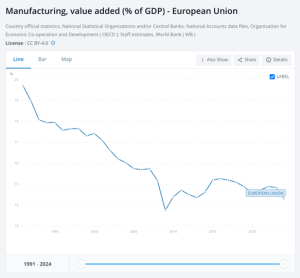
Source of the graph: Manufacturing, value added (% of GDP), European Union | Data
This decline hits precisely the sectors that determine the energy transition. Without European steel, there are no locally produced wind turbines or grids; without European chemicals, there are no advanced materials, no competitive batteries, no transition molecules made in Europe. Deindustrialisation is therefore not just a matter of jobs or GDP; it directly weakens the continent's ability to decarbonise using its own resources. These are dependency chains that now extend well beyond fossil fuels.
This trend also jeopardises the stated political goal of bringing industry back to 20% of European GDP by 2035. Without a structural reduction in energy costs and a stable regulatory environment, this goal will remain a rhetorical horizon rather than a credible political course.
4. Why decarbonisation needs abundant energy
A flawed line of reasoning has taken hold in part of the European debate: the belief that the transition will succeed through scarcity and energy contraction. In reality, decarbonisation and the circular economy are energy-intensive processes. Decarbonisation requires electrifying transport, heating and part of industry, modernising networks and building new production capacity. A more circular economy means energy is consumed to recycle, transform and reuse materials.
Around 75% of European greenhouse gas emissions still come from the energy consumed each year. This is because the final energy mix includes only a limited share of genuinely decarbonised energy, when combining renewables and nuclear. Under these conditions, artificially and too rapidly raising energy prices before an abundant supply of low-carbon energy has been rolled out means trapping households and businesses in an inflationary spiral with no available alternatives.
Expensive energy therefore slows decarbonisation instead of speeding it up. It makes electrification more costly, expensive low-carbon electricity makes low-carbon hydrogen production projects unviable, undermines investment in clean industrial sectors and increases the risk of carbon leakage as production relocates to countries that are less demanding but more energy-competitive.
5. The causes of rising energy prices
a. Geopolitical shocks and supply vulnerabilities
The price pressures we are currently experiencing stem first and foremost from geopolitics. The invasion of Ukraine, the reduction in Russian gas flows, tensions in the Middle East and the vulnerability of shipping routes have all been reminders that energy is never a simple commodity: it is an instrument of power. The development of liquefied natural gas (LNG) brought flexibility but also exposed Europe more to global market volatility, available liquefaction capacity and logistical strains at terminals.
The blocking of the Strait of Hormuz or the destruction of infrastructure in Qatar are not peripheral events for Europe: they directly threaten the oil and gas flows on which the European economy still largely depends. As a result, the Union has increasingly faced external shocks with insufficient room for manoeuvre, having failed to diversify its routes, suppliers and storage capacity in time.
b. Underinvestment and taboos surrounding transition energy sources
At the same time, Europe has adopted an increasingly hostile stance towards hydrocarbons, even during the transitional phase in which they remain indispensable. This hostility has discouraged certain investments in exploration, production, transport and flexibility infrastructure, even though actual demand had not yet fallen sufficiently. The result is a mismatch between stated political ambitions and the physical realities of the energy system.
This contradiction is visible in the EU's persistent dependence on oil and gas, which still account for the bulk of final energy supply, while electrification of end-uses remains incomplete. Reducing fossil capacity too quickly without an abundant, dispatchable and competitive alternative in place automatically leads to higher prices, greater volatility and weakened supply security.
Meanwhile, the European Union failed to capitalise on the leading source of electricity generation it had at its disposal: nuclear power. Indeed, European Commission President Ursula von der Leyen lamented last year the Union's strategic mistake of allowing nuclear power's share of the electricity mix to decline significantly over the past 20 years, precisely when it needed to be expanded.
In another, equally concerning respect: renewable energy has successfully achieved industrial scale-up, with prices per installed unit falling considerably. Yet Europe, which has actively supported these sectors for over 20 years, has allowed almost all of its wind, battery and photovoltaic production chains to disappear.
c. Taxation, surcharges and system costs
Beyond geopolitical shocks, the final energy price in Europe is being pushed up by a growing number of bill components: taxation, surcharges, funding for support mechanisms, network costs and regulatory obligations. Part of the cost of the transition has been shifted into structural and mandatory items on energy bills, weighing more heavily on lower-income households and on businesses, whether or not they are exposed to international competition.
This is compounded by an approach that too often looks only at the cost of technology (LCOE: Levelised Cost of Energy) rather than the full system cost. Intermittent renewables may have a low marginal cost, but they require substantial investment in grids, flexibility, storage and dispatchable back-up. A serious energy policy must therefore be based on the overall system cost, robustness and supply security, rather than partial signals.
6. European regulations that risk significantly increasing the bill
a. ETS II: a potentially socially explosive price signal
Extending the carbon market to buildings and transport through ETS II follows, in theory, a coherent economic logic: internalising the cost of carbon in the price to shape behaviour. But a price signal is only useful if it remains socially sustainable, meaning it operates over the long term, and enables credible alternatives to emerge. In areas where fossil-fuel heating still dominates and cars remain essential, too rapid a rise in the CO2 price would first translate into a burden on households and certain SMEs, without adequate compensation.
Without a capping, modulation or phasing mechanism, ETS II could help entrench structurally very sharp increases in fuel and heating prices. This would expose the Union to a major political and social backlash, while undermining support for climate policies. A climate path without social acceptability is a path doomed to instability.
At the same time, a further acceleration in the reduction of quotas under ETS I risks pushing up energy prices even more for industry and for the power plants that set electricity prices. As noted above, these sectors are highly sensitive to international competition and are already suffering from excessively high energy prices.
b. RED III: the risk of costly technology mandates
The RED III directive aims to accelerate the deployment of renewables, which is legitimate in itself. But when it translates into highly detailed incorporation or deployment obligations, it can create extra costs where other low-carbon options would be more efficient or better suited to the national context. Such an approach reduces Member States' freedom to choose the mix best suited to their resources, grids, industrial base and energy heritage.
Moreover, if these obligations mainly result in increased imports of technology manufactured outside Europe, particularly in China, the economic cost rises without any real gain in sovereignty. The transition would then take place with factories elsewhere, subsidies here, and European consumers footing the bill.
c. EPBD IV: the investment cliff in the building sector
Improving the average energy performance of buildings is necessary, particularly for homes that are energy-guzzling wrecks. But when a European standard imposes overly uniform targets on highly diverse building stock, it can produce the opposite of the intended effect. In regions with old and scattered housing, the financial burden becomes so heavy that it limits the number of renovations actually feasible, to the detriment of the very households in precarious situations.
The risk is twofold: on one hand, many owners are required to carry out works beyond their financial means, risking restricted access to home ownership for part of the population, particularly younger people; on the other hand, it blocks public policies that, with more flexibility, could help a far greater number of households escape energy poverty. An unrealistic standard is not an ambitious standard; it is often an unworkable one.
d. CBAM and regulatory overload: the risk of paralysis
The carbon border adjustment mechanism pursues a defensible objective, indeed a crucial one for the Union, which imposes a carbon cost on all its economic activities: preventing carbon leakage by taxing imports according to their carbon intensity. But if it is added to other costly mechanisms without overall simplification, it increases administrative complexity, uncertainty and compliance costs, particularly for already weakened industrial sectors. Moreover, CBAM covers only about 25% of current imports, with ways to avoid it fairly easily for certain foreign importers. It needs to be simpler and apply to all imports.
More broadly, the EU has accumulated dozens of texts, plans and sub-objectives, creating a regulatory jungle that is difficult to read, even contradictory, for economic actors as well as public authorities. This system discourages long-term investment, diverts resources towards compliance rather than innovation, and too often turns national governments into mere procedure managers.

7. Measures to restore our energy sovereignty and European competitiveness
a. Making abundant and affordable energy an explicit objective of the Union
The first measure consists of putting in black and white the objective of abundant and affordable energy at the heart of European policy, on an equal footing with carbon neutrality and the internal market. Without controlled energy costs, there will be neither a robust industrial base, nor sustainable purchasing power, nor an accepted transition.
Every new European package should be assessed against three simple criteria: security of supply, cost/competitiveness, and climate impact. This requires integrating genuine monitoring of energy competitiveness into the European Semester: industrial gas and electricity prices compared with the United States and Asia, the share of imported energy, and the weight of taxes and surcharges in bills. When too large a gap appears, for example when European prices remain several times higher than American and Chinese prices, a correction mechanism should be triggered: review of certain standards, targeted tax adjustments, recalibration of support schemes. Affordable energy must once again become a legitimate political objective, not a blind spot of European strategy.
b. Fully exploiting, within a demanding framework, European energy and mineral resources
Sovereignty requires making better use of resources available on European territory. This means re-evaluating without taboo the potential of shale gas, onshore and offshore hydrocarbons, and critical minerals needed for the transition. Europe cannot claim sovereignty while refusing, as a matter of principle, any exploration or extraction capacity on its own soil.
Strictly regulated pilot projects could be authorised to objectify debates on shale gas or certain offshore resources, with high requirements on water quality, fugitive methane emissions, site restoration and public transparency. The American experience shows that extraction combined with robust regulation can have a major effect on security of supply and the cost of gas.
At the same time, a European mining policy must be embraced. The metals and rare earths needed for batteries, grids, wind turbines, electrolysers and digital technology are strategic resources. Accelerating a few key projects within a demanding environmental framework would reduce dependence on external supply chains, re-anchor industrial activities on the continent and increase Europe's geopolitical credibility.
c. Massively diversifying supply sources, routes and technologies
Diversification must once again become the guiding principle of European energy policy. Diversifying suppliers, routes and technologies reduces vulnerability to a single shock and increases the resilience of the system. The experience with Russian gas flows and the Strait of Hormuz shows that no excessive dependence is neutral. On gas, this requires long-term contracts with a range of suppliers, strengthened LNG terminals, more robust gas and electricity interconnections, and a more ambitious approach to storage. LNG now represents a central part of European imports and must be seen as a pillar of flexibility and security during the transition phase. On electricity, diversification requires intelligently combining nuclear, hydropower, renewables, targeted storage and flexible backup capacity, rather than artificially pitting these options against each other. A policy based on the full system cost is more robust than a dogmatic approach relying on a single family of technologies.
d. Thoroughly reforming ETS, RED III, EPBD IV and CBAM
We must keep effective climate instruments, but make them sustainable, understandable and predictable. For the carbon market, this means price corridors with caps per period, to avoid spikes that ruin competitiveness and socially destabilise households. Modulation or suspension clauses must be provided for in the event of a major crisis or particularly aggressive climate dumping.
For RED III, the priority should be to move away from a logic of rigid technological obligations. Member states must regain the freedom to choose their energy mix based on outcome targets for emissions and security of supply, rather than detailed prescriptions on the means. This flexibility is essential to respect differences in resources, networks and industrial fabric between states.
For EPBD IV, it is preferable to aim for realistic and gradual trajectories: prioritising the worst energy-guzzling buildings, setting average improvement targets and allowing hybrid solutions suited to local realities. Finally, CBAM must be simplified so that it does not become an additional administrative layer that stifles industrial players without genuinely improving European sovereignty.
e. Placing industrial sovereignty and energy competitiveness at the heart of the transition
The energy transition will not succeed against industry, but with it. The goal of bringing industry back up to at least 20% of European GDP requires guaranteeing strategic sectors sustainable access to competitive, predictable and low-carbon energy. This concerns primarily the steel industry, chemicals, metallurgy, materials, batteries, electrical components and critical digital technologies. Targeted mechanisms are needed to secure the energy supply of these sectors: long-term contracts, reduction of certain surcharges, targeted support for low-carbon investments, and better control of network costs for energy-intensive sites. At the same time, European financial instruments must be redirected more towards cleantech production in Europe, to reduce the cost gap with Asian competitors and give rise to genuine European industrial champions.
Public authorities must also more systematically apply the criterion of cost per tonne of CO2 avoided when allocating support (abatement cost). Too many resources are still spread across measures with marginal climate benefits, while more effective industrial or electrical levers remain under-mobilised.
f. Embracing genuine low-carbon technology neutrality, with a central role for nuclear power, which is indispensable in Belgium
Technology neutrality cannot be selective. Any safe, dispatchable or competitive low-carbon technology must be able to contribute to European decarbonisation on an equal footing. This means, in particular, fully recognising nuclear power as a sustainable energy source, not merely as a transitional one. The decline of nuclear power in the European electricity mix has been acknowledged as a strategic error at the highest level of the Commission. The consequences must be drawn: allowing the extension of existing reactors where safety permits, facilitating investment in new capacity, including small modular reactors, and guaranteeing a non-discriminatory financial and regulatory framework.
In this logic, technological comparisons must be made on the basis of the full system cost, not merely the apparent production cost. Grids, flexibility, storage, resilience to crises and security of supply must be fully integrated into the assessment of energy choices.
g. Launching a major European “Energy Sovereignty & Industry” package
The Union needs an integrated strategy, not a stack of partial responses. A major European “Energy Sovereignty & Industry” package would make it possible to bring together electricity market reform, gas strategy, mining policy, support for cleantech produced in Europe and protection of critical infrastructure.
On electricity, the aim is to reduce excessive volatility, give major industrial investors visibility and better protect consumers from gas shocks. On gas, the role of LNG and transitional gas in a medium-term security of supply strategy must be clarified.
On raw materials, the Union must identify critical value chains, support a few structuring projects on its territory and forge strategic partnerships with third countries for resources that cannot be produced in Europe. This package should also include a strong dimension of physical and cyber security for energy infrastructure, in a context where energy is increasingly used as leverage in international power struggles.
h. Adapting the decarbonisation trajectory to reconcile 2050 neutrality, growth and solidarity
The goal of carbon neutrality by 2050 must be maintained. Intermediate milestones, however, must be adjustable if their simultaneous implementation causes disproportionate costs for households and businesses. A good climate policy is one that lasts over time; it must therefore be economically viable and socially acceptable. Carbon neutrality will not be achieved by making energy scarce and expensive, but by increasing the supply of low-carbon energy, improving energy efficiency and electrifying uses where this makes economic and technical sense. Any strategy relying mainly on forced consumption reduction would expose the Union to recession, social anger and lasting political rejection.
The social dimension must also be fully integrated. Energy is among the main sources of hardship for European households, and price increases hit hardest those with the least capacity to adapt.
Targeted tools (temporary aid, renovation support for the most disadvantaged, affordable mobility solutions) are essential to preserve democratic support for the transition.
i. Returning to a pragmatism based on engineers, entrepreneurs and states
Ultimately, success will depend on a new method. Europe must move away from the “one problem, one new plan” logic, which has produced an excessively complex, shifting and often contradictory framework. A credible strategy must focus on a few clear outcome objectives and allow greater freedom regarding the means to achieve them. This requires significantly simplifying texts, merging overlapping schemes, removing low-value obligations and shortening authorisation procedures for strategic projects. National ministers must remain able to adapt tools to their energy, industrial and territorial realities, rather than becoming mere managers of regulatory transposition.
8. Conclusion: the choice of power
Europe stands at a turning point. Either it persists on a path where energy costs remain durably higher than those of its major competitors, risking accelerated deindustrialisation, dependence and impoverishment; or it chooses to return to a power-based policy founded on energy abundance, industrial sovereignty and pragmatic decarbonisation.
Making energy abundant, affordable and low-carbon is not contradictory; on the contrary, it is precisely the condition for credible electrification, successful European reindustrialisation and regained strategic autonomy. Europe does not need scarce and overpriced energy; it needs safe, competitive energy compatible with the climate, in order to remain a free, productive and influential continent in the 21st-century world.
This return to pragmatism must be embraced as a choice for power. It is neither bureaucracy nor technological dogma that will make Europe more prosperous, more sovereign and greener; it is choices grounded in physical reality, industrial intelligence and the capacity for innovation.