
The PISA 2025 results confirm a worrying observation the MR has long made: in the Wallonia-Brussels Federation, our pupils are declining in both mathematics and reading. These difficulties are long-standing and structural. For twenty years, rigour, effort and discipline were taboo at school. With one of the highest levels of funding in the OECD, our schools must do much better. These PISA results allow for neither complacency nor inaction. They make the reforms undertaken by Minister Valérie Glatigny more necessary than ever.
The PISA 2025 results are not good. Let's not sweep this under the carpet: since 2018, we have lost 28 points in mathematics and 15 points in reading. In science, the results are more stable: -3 points since 2018 and +3 since 2022.
As other countries decline sharply, the Wallonia-Brussels Federation now sits around the OECD average in all three assessed areas: 482 points in science, 467 in mathematics and 466 in reading.

PISA results in maths over 23 years
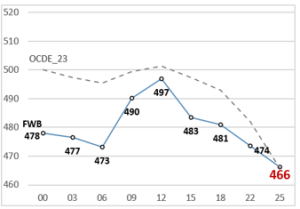
PISA results in reading over 25 years
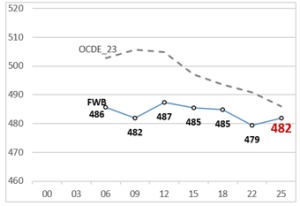
PISA results in science over 20 years
Reaching the OECD average unfortunately does not mean our education system is improving: our performance has been steadily declining in all three areas for many years. We reject this definition of progress through a levelling-down whereby we would be satisfied simply because others are declining more. Our performance still lags behind that of Flanders.
That said, the WBF is holding up better than some of its neighbours: over the long term, it has, for example, fallen by 12 points in reading since 2000, compared with 68 in Flanders and 91 in the Netherlands. However, our goal is not to be “less bad” or to decline more slowly than others! We want to reverse the trend and break the negative spiral of PISA results by drawing inspiration from the best.
This is not about simply copying a foreign model, but drawing inspiration from good practice. High-performing systems (Japan, United Kingdom, Canada, Estonia, etc.) differ from one another, as do their societal contexts, but several constants recur:
- A high level of demands.
- Strong focus on basic learning.
- Rapid intervention as soon as difficulties appear,
- A classroom environment conducive to work, discipline and concentration, with teachers supported in their practice.
- Enhanced teacher training.
- Respected teachers.
This is all the more necessary given that we devote significant resources to our education system. We rank among the OECD's top 5 in terms of funding. Yet our pupils' skills are not in the top 5, but rather between 15th and 23rd place. If success depended solely on the budget spent, we should be achieving far higher results.
As a reminder, out of every 100 euros of tax in Belgium:
- €21.24 funds pensions;
- €14.8 funds healthcare;
- €11.7 funds education;
(…)
In 12th position: €2.4 for Defence.
These results cannot be attributed to the reforms undertaken by the current majority. Indeed, the pupils assessed by PISA were 15 years old at the time of the survey. They cannot be read as an assessment of the Pact for Excellence in Teaching. They reflect older, structural difficulties specific to our education system, marked by the fact that over the past 20 years the words “rigour”, “effort” and “discipline” became taboo. The reforms being undertaken today aim precisely to address this challenge.
PISA also speaks to effort, discipline, absenteeism and concentration
There is no single cause explaining the results. The OECD in fact points to a cluster of school-related, individual and societal factors which, combined, weaken learning.
Some of the signals sent should concern us: greater difficulty with long texts and complex intellectual tasks (linked to AI and social media), declining attention, effort and perseverance, less enjoyment of reading and rising absenteeism. In classrooms, the disciplinary climate is deteriorating, particularly in mathematics and French. In science it is improving slightly, but remains among the least favourable in the OECD. Perceived family support is also declining and below the OECD average.
Making this observation does not mean holding pupils or their parents responsible for the poor results. The quality of learning depends on what happens in the classroom, on how our system is organised, on the pupil's engagement and on the surrounding environment. Nor can we refuse to speak of effort, perseverance, attendance or the role of families when these elements clearly emerge from the OECD survey.
We must dare to speak again about the importance of discipline and good management of the school climate. This is not about promoting an authoritarian school, or believing that the solution is simply more punishment. It is about restoring a clear framework that places each party back in their role, duties and rights, in which the teacher is able to teach and the pupil to learn. The comparison with Estonia is telling here: according to the Talis 2024 study, around 9 minutes out of every 100 are devoted to discipline and the school climate there, compared with 21 minutes here. This lost time is time not devoted to learning.
The school climate is obviously not limited to discipline. It also requires tackling bullying and cyberbullying, ensuring a calm environment for pupils and restoring respect for teachers and their authority. It is precisely this combination of rigour, a calm school climate and authority that is found in the highest-performing education systems.
Our response: break the negative spiral, draw inspiration from the best with greater rigour, and promote effort and perseverance
The lessons of PISA confirm the need to put basic learning back at the heart of the school journey, and above all to intervene earlier when difficulties arise.
For too long, speaking of rigour, effort or discipline was considered taboo. Yet PISA reminds us of an obvious truth: we will not durably raise learning standards without also putting rigour and a taste for effort back at the heart of school. These results reinforce our conviction: raising mastery of learning requires combining high expectations with stronger support for pupils.
This is the purpose of the CLÉ test, organised for the first time this school year at the start of the 4th year of primary school, covering arithmetic, reading and writing. Its aim is not to punish or rank pupils, but to obtain a precise picture of each pupil's learning so as to intervene precisely and quickly on anything that might hinder the proper continuation of their studies. We no longer want to let a pupil progress from year to year with difficulties in basic learning.
This is also the meaning of raising the pass threshold for external certifying assessments from 50% to 60%. The signal sent is one of a higher level of rigour. Since the start of this school year, an additional mathematics period has also been introduced in the 1st year of secondary school, as well as two digital technology periods. These are not limited to learning IT tools: they aim in particular to develop understanding of algorithms, critical thinking about online content and a sensible use of social media. The goal is to give pupils the keys to understand and master their digital environment rather than endure it, notably in response to the PISA survey's findings on the effects of digital distraction and certain uses of social media on learning.
This signal goes hand in hand with greater support. 460 additional full-time equivalents are tasked with providing personalised support to pupils in primary school and the 1st year of secondary school. This represents around €25 million, which notably allows for additional support and, where necessary, co-teaching (two teachers in a classroom) for pupils whose difficulties the CLÉ test has identified.
In addition to this personalised support, “enhanced support” is provided in the 1st year of secondary school, to concentrate more support on pupils who struggled with the CEB.
Acting on learning, but also on the conditions in which it takes place
The PISA survey finally confirms that we must also act on everything that enables learning to take place under good conditions. Our actions therefore aim to restore a school climate conducive to learning:
- Ban on recreational smartphone use during school time: to improve pupils' concentration and attention, given that the PISA survey notes a decline in these along with greater difficulty with complex intellectual tasks. The use of digital tools for educational purposes remains relevant and is encouraged.
- Stepping up the fight against bullying and cyberbullying, with €8 million mobilised over four years. A climate conducive to learning is also one in which a pupil can come to school without fear of being bullied.
- Protection of teachers: the new Criminal Code fully recognises teachers among those performing a societal function and strengthens their protection against verbal or physical violence in the course of their work.
- Teachers' pedagogical authority: ending the automatic nature of certain appeals is also intended to restore confidence in their pedagogical expertise. A teacher must be able to carry out their profession while being respected, protected and reinforced in their authority.
- Earlier action against absenteeism and school dropout: the PISA survey notes a rise in absenteeism in the WBF since 2022. Families are now alerted after four and a half days of unjustified absence. If absences continue, support is strengthened with the PMS centres and, if necessary, youth welfare services. The new PLP41 circular (with Minister of the Interior Bernard Quintin) also strengthens prevention by providing a police liaison officer for each school, to facilitate dialogue and faster intervention when signs of dropout coincide with a minor at risk or a risk of sliding into juvenile delinquency. The aim is to act as early as possible, before the spiral of failure or lasting dropout takes hold.
- Strengthening the quality and appeal of vocational education: the PISA survey reveals a significant performance gap depending on the school pathway. Pupils on track in general education achieve very good results, while those who have repeated a year and attend vocational education show markedly weaker performance. The answer cannot simply be to delay orientation: vocational education must become a positive choice based on successful learning on the one hand and a guided pathway on the other, rather than the result of successive failures. This is what we are doing, notably through orientation activities in secondary school, the systemic reform of vocational education and the development of work-study programmes.
Finally, let us highlight a few positive aspects noted by the PISA survey:
- Greater equity in pupils' results based on their socio-economic background;
- A certain stability in our science results, where others are registering a sharp decline.