
Faced with a worrying budgetary situation and difficult economic prospects, the MR welcomes the King's decision to task the Prime Minister with resuming negotiations towards a budget agreement. Raising taxes in one of the most heavily taxed countries in the world is not the right answer. For the MR, the priority is clear: reduce state spending, revive economic growth and protect the purchasing power of Belgians. It is time for political courage, we owe this to the citizens of our country. We must work seriously and with the will to succeed.
- Faced with the budgetary and economic situation, the MR calls for collective responsibility
Faced with the deadlock in the federal budget negotiations, the Mouvement Réformateur calls on the governing coalition to take collective responsibility. The time for political posturing and sterile taboos is over; what is needed is a multi-year, coherent and ambitious budget agreement. It is time to give citizens and businesses a perspective.
L’aboutissement des négociations budgétaires n’est pas un impératif politique, il s’agit d’une nécessité économique double : la situation budgétaire du pays est particulièrement préoccupante alors même que
la croissance économique reste trop faible et l’inflation trop importante. Si nous ne faisons rien, le cocktail se révèlera explosif.
That is why the Mouvement Réformateur strongly welcomes the King's decision to task the Prime Minister with reaching an agreement. We are also pleased that the Royal Palace insists on the importance of stimulating economic growth – an objective championed and upheld by the MR.
- Belgium is facing budgetary urgency!
For years, successive governments have widened the deficit – the current governments have inherited a worrying situation: in 2025, Belgium recorded the worst budget deficit in the entire European Union (5.2% of GDP).
In other words, the State spent €33 billion more than it earns – that is colossal. By comparison, a country with a similar social security system and tax burden to ours, Denmark, posted a budget surplus.
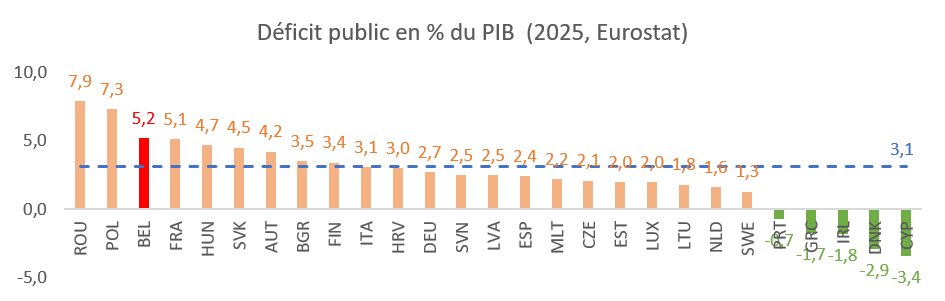
This situation results in colossal debt for our country: 107.9% of GDP in 2025. The only countries doing worse are Greece, Italy and France. By comparison, Denmark's debt stands at only 27.9% of its GDP.
Our abysmal debt has very concrete effects: in 2026, the federal State will pay €12.5 billion in interest charges – that is equivalent to 4 times the budget of the FPS Justice!
Belgium is the third-highest tax-collecting state in Europe, yet we have the worst deficit. The conclusion is clear: we must not raise more taxes, we must seriously control our spending – and indeed, we have already done so in the past!
- Trends in State revenue and expenditure
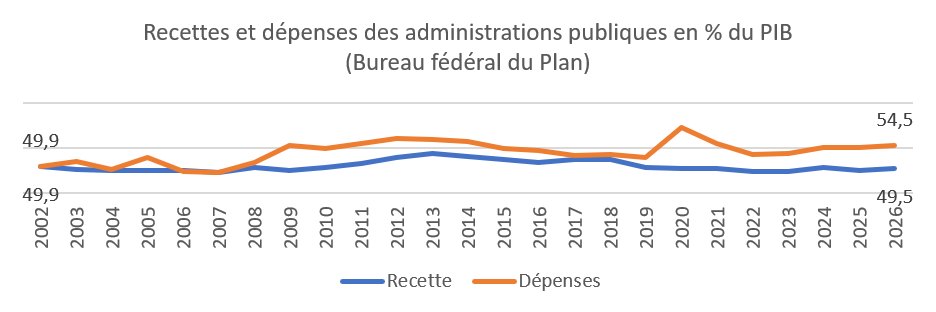
Revenue as a % of GDP between 2002 and 2026 is almost identical: this is a normal situation, State revenue has grown at the same pace as GDP – that is, as the wealth created.
Expenditure, on the other hand, will represent 54.5% of GDP in 2026, 4.6% more than in 2002. The conclusion is clear: spending has grown much faster than newly created wealth. In 2026, expenditure will exceed revenue by 5% of GDP!
This is a legacy of past poor management: spending rises sharply during the 2008 and 2020 crises – but never returns to its pre-crisis level. Denmark, for example, manages to reduce its spending once a crisis has passed. In Belgium, public intervention is therefore not countercyclical: previous governments did not save when the economy was doing well.
Worst of all, Belgium spends particularly poorly: in Europe, 16 countries spend less for a better quality of public policy. Denmark, once again, stands out with the best quality in the whole European class!
It is plain to see, we must reduce our spending. We can do more by spending less. Denmark proves it: it is possible to cut spending while guaranteeing a remarkable quality of life.
- Debt and interest charges
The deficits recorded under previous legislatures caused debt to explode – indeed, to maintain out-of-control spending, the State had to borrow massively.
The governments currently in office are paying dearly for this. Indeed, this high level of debt leads to a spiralling of interest charges – through two mechanisms:
First, as the stock of debt increases, interest charges have mechanically soared.
Secondly, the legacy of these deficits and this high debt undermines the confidence of financial markets 🡺 the interest rate rises: by the end of October 2026, the Belgian ten-year rate reaches a peak of 4.4%, compared to 3.4% in Germany.
These high interest charges pose a significant problem: they prevent the State from using that money to implement its policies. For example, the federal State will spend around €12.5 billion in interest charges in 2026. That amount is equivalent to 4 times the budget of the FPS Justice.
If we do nothing, the interest burden will rise to €18.6 billion by 2029, an increase of 49% in 3 years! The latest estimates from the Federal Debt Agency and the National Bank of Belgium even point to interest charges of €20.4 billion in 2029.
Reduce spending 🡺 reduce debt 🡺 reduce interest charges 🡺 free up resources for ambitious policies!
- How to address the deficit and control the evolution of debt
Since the federal and regional governments took office, the MR has made it a point of honour to reduce the deficit inherited from past policies. The purpose is clear: without strong action, the State will be further strangled by interest charges. In the worst case, financial markets could even refuse to lend additional funds. We refuse to give in to fatalism, we work every day to implement ambitious reforms to safeguard a dignified social security system and free up resources for new policies!
To address the deficit, there are three options:
- Increase revenue,
- Reduce spending,
- Accelerate GDP growth (the denominator of the key deficit/GDP indicator).
Today it is clear that we must reduce spending and accelerate growth:
Augmenter les recettes, cela veut dire plus d’impôts. La Belgique est le 3ème Etat européen qui prélève le plus (en % du PIB) – nous pouvons difficilement faire ‘mieux’.
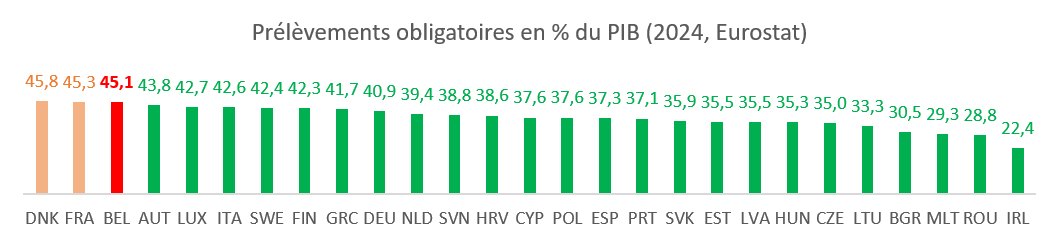
Mais pire encore, il s’agit d’une solution de facilité qui viendra freiner la croissance de nos entreprises et le pouvoir d’achat de nos ménages.
For the Mouvement Réformateur, this is a red line: we refuse to fund a bloated and inefficient State by squeezing even more out of Belgians' pockets. From day one, we have opposed the linear increase in VAT rates – the most unfair tax, yet the easy option for other political parties.
The left will argue that taxing the wealthiest is the solution – forgetting that, according to the European Commission, revenue as a % of GDP from various wealth taxes is the highest on the continent in Belgium! For some, a Belgian who holds capital of €500,000 or who carries out a professional activity through a company is already suspect.
- The only solutions available to us
Given the above, 2 solutions are imperative for the country: reduce uncontrolled spending growth and accelerate growth
Reducing spending has become a necessity – primarily to sustain our social security system and free up resources for ambitious policies. It is necessary to:
- Controlling the growth of healthcare spending:
Today, the healthcare budget is automatically indexed to inflation – but on top of that, it is indexed by 2% to 3% above inflation each year – this is the healthcare growth norm. With inflation at 4%, and a growth norm of 2% – 6% in total – on a budget of over €40 billion, the impact is colossal. Such a trend is unsustainable in an economic context close to recession. This norm needs to be revised downwards – indeed, according to the IMF, 20% to 30% savings are possible through greater efficiency. But other measures must also be implemented, in particular:
- Returning long-term sick people who are able to work to employment,
- The reform of the increased reimbursement status, which has strayed from its original purpose,
- The – reasoned – review of the co-payment system.
- Reducing the size of the public sector:
A study has shown that implementing AI in public services in the Netherlands would generate a 20% efficiency gain!
The OECD also points out that the wage bill of the Belgian civil service is 1.5 percentage points higher than the OECD average.
- Simplifying the structure of the State:
How can we explain that Belgium has 26 political mandate holders per 10,000 inhabitants compared with 5 in Denmark? This is why the MR is actively working on concrete reforms: abolishing the Senate, abolishing the Provinces, merging municipalities. Our goal is to simplify the State structure to generate synergies and increase the efficiency of public policies.
- Accelerating GDP growth must be at the heart of every political project.
- Lower the tax burden to encourage consumption and investment: this is why we advocate, among other things, lowering VAT on new construction,
- Reduce the size of the State – there is a strong negative correlation between the size of the State and economic growth,
- Increase the private employment rate so that everyone can achieve their potential: this is what we are doing by making the labour market more flexible, increasing the gap between workers and benefit recipients, and gradually returning long-term sick people to work,
- Reduce the administrative procedures that hold back businesses,
- Improve the confidence of businesses and entrepreneurs,
- Invest in innovation, one of our country's strengths,
- Improve access to financing for our businesses.
- Accelerating GDP growth must be at the heart of every political project.
Because growth is essential, our federal Ministers Clarinval, Bihet and Simonet produced an ambitious growth plan last September identifying concrete measures to meet these imperatives.