
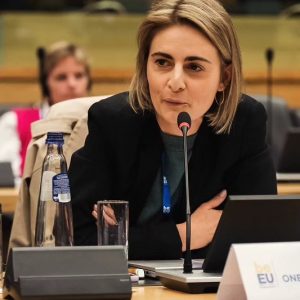
As alderwoman of the municipality of Silly, Violaine Herbaux is also chair of the ONE, the Office de la Naissance et de l’Enfance. Education, early childhood and health have been her portfolios since 2017. She is also an adviser to the Presidency on these same topics. Today, she is setting herself new challenges.
You've just been designated lead candidate for the municipal elections: does the position of mayor tempt you?
Of course. Being lead candidate not only means leading a team to win an election campaign, but also, and above all, accepting and wanting to lead a team in municipal management. As 1st alderwoman, I stand in for the current mayor, Christian Leclercq (who will not be a candidate in October 2024), during his absences. This is a mission I take on with enthusiasm and seriousness. Moreover, I am deeply attached to and rooted in my village. This is a local connection going back several generations. Together with my team, I want to keep watching over the development of our municipality so that it remains a good place to live, but also over the use of public funds to preserve everyone's purchasing power.
You are also a federal candidate, what are your priorities there?
There are several. First, increasing purchasing power and reducing taxes for those who work. This is an absolute necessity if we want to encourage employment and get people off welfare dependency. Next, tackling labour shortages. We need to limit unemployment benefits over time, reform support for job seekers and take measures to address the constant rise in the number of long-term sick. Finally, health, and more specifically access to innovative treatments. On average, 534 days pass between obtaining market authorisation and reimbursement, placing Belgium 23rd in Europe. Moreover, only 1 in 2 medicines that receive market authorisation is actually available to patients. We need to review the Belgian system for bringing medicines to market, reform the Medicine Reimbursement Commission and simplify administrative procedures.
You are chair of the ONE, what are the challenges?
I remember my first board meeting. I was very impressed. There were a lot of people around the table and the members' knowledge of the sector was of a high standard. I had to quickly familiarise myself with the organisation of the services, the jargon, and so on. 7 years later, I believe I have a good grasp of how things work, the strengths but sometimes also the weaknesses of the structure.
In this way, the ONE must continue to modernise and adapt, not only to the new missions entrusted to it following various reforms, but also to the challenges facing society. The Board of Directors will continue to support the Office in its development in order to improve the efficiency and quality of its services.
Creating new childcare places for young children must remain a top priority. There is still a shortage of childcare places in the Wallonia-Brussels Federation. The public sector (which provides subsidies) plays its part. But it is now time to acknowledge that some models have reached their limits. That's why public-private partnerships and business investment in the sector are an opportunity to be seized in order to diversify and increase the childcare offer.
Out-of-school care (ATL), the child's third living environment, needs more support. This means prioritising support for employment, training and stable employment contracts. A balance must be struck between accessibility and quality. Care must be taken not to slide into an “everything for free” approach, which unfortunately does not always guarantee quality services.
Finally, the ONE must stand by families and children in vulnerable situations. The ONE plays an important role starting with prenatal support, but also in the child's development. As alderwoman for education, I have unfortunately had to call on the SOS Enfant teams too often (whose mission is to deal with situations where children are victims of physical, psychological, sexual or institutional abuse or neglect). These field teams are essential and must be given the means to carry out their role under the best possible conditions.
Combining family life and political commitment, is that easy? What's your recipe?
Let's be honest, balancing family life and professional life (political or not) remains a tricky exercise. But as I often repeat, it's a matter of organisation, prioritisation and family support. I'm lucky to be able to count on a very close and united family. I set aside time for politics and time for family. I also avoid getting caught up in the superfluous, so I can focus on what matters. Finally, I keep myself as far as possible from social media and any form of negativity that could affect my morale and peace of mind.