
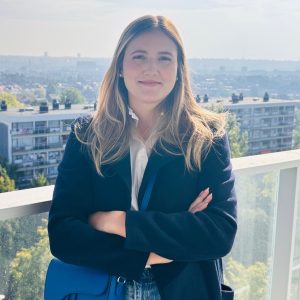
In Anderlecht, a cosmopolitan and working-class municipality of Brussels, Marcela Gori embodies a rarely seen journey: born abroad, arrived undocumented, became a business owner, lawyer, mother of three daughters… today a local elected representative and deputy chair of the CPAS and Foyer Anderlechtois.
She champions an ambitious vision of social support: help to get back on your feet, not permanent comfort.
You have an exceptional life story: arrived in Belgium undocumented, now a business owner, lawyer and mother of three children. Can you walk us through the main stages of this atypical journey?
The first thing I want to say is thank you. Thank you to Belgium, but also to the Belgian people for welcoming me. I don't forget my roots, but I am deeply happy to be Belgian. I arrived here at the age of 13, without papers and without a network. Like many others, I had to learn quickly, work hard and fight three times as hard to succeed.
The early years were about survival and adaptation: learning the language, understanding the codes, integrating into a country that doesn't necessarily wait for you.
Gradually, through school, work and great perseverance, I was able to build stability. Alongside my law studies, I set up a business that today employs around fifteen people, before then making the leap to the bar. Becoming a lawyer represented for me both a form of social vindication and, above all, a concrete way to understand the rules in order to apply them better: and sometimes to help change them.
Today, at 29, I am also a mother of three daughters. It's a daily responsibility that keeps me grounded and guides many of my choices: I want a society that gives opportunities, but also holds people accountable. My journey has taught me that nothing is impossible, but nothing is automatic either.
How did you go from civil society to becoming deputy chair of Anderlecht's CPAS? What pushed you to enter politics?
I didn't get into politics out of calculation or personal ambition, but out of a need to act. The need to move away from rhetoric disconnected from everyday life, to stop speaking on people's behalf without ever starting from their reality.
My professional path allowed me to closely observe the social realities of our municipality and region: precariousness, rising insecurity, but also the limits of a system that, by endlessly multiplying free policies without the means to sustain them, ends up offering little perspective and even less collective ambition. I refuse to watch my children grow up in a municipality and region where the everyday is managed without ever building the future.
The CPAS is an essential tool for those who truly need it, but it becomes less effective when it limits itself to managing emergencies without setting a clear course towards independence. Becoming deputy chair of Anderlecht's CPAS therefore became an obvious choice: acting where decisions have a direct impact on people's lives. Helping, yes, but with rigour, responsibility and consistency. To build lasting solutions rather than maintaining stuck situations that repeat year after year.
You recently proposed that every municipal councillor should master at least one national language, arguing for better communication with citizens. You said “you can't run a municipality with Google Translate”. Do you see this as an essential prerequisite for democratic practice and living together?
Yes, absolutely. Language is not an administrative detail, it's a fundamental democratic tool. In Brussels, and especially in Anderlecht, citizens are multicultural and multilingual, but administration rests on precise rules. An elected representative who doesn't master at least one national language always depends on an intermediary. And depending on others means losing responsibility and independence. Using an automatic translator to understand a regulation, a budget or a legal decision is not serious. Nor does it show respect for citizens. My position isn't about identity, it's pragmatic: understanding well means deciding better. And deciding better means governing together better.
More generally, I also believe that learning the language of the country that welcomes you is the bare minimum. How else can you understand administrative documents, make friends, or stay in touch with your children's school? For too long we've accepted people living cut off from society in isolation.
In a recent op-ed, you pointed to the pitfalls of a welfare system that, in your view, deSocialises rather than helps; you called for a liberating CPAS, not a “poverty trap”. Can you share your vision of ideal social support: what principles, what priorities so that the CPAS becomes a lever for independence rather than dependency?
Social support must be a springboard, never a way of life.
An effective CPAS is one that helps people get back on their feet, not one that keeps them dependent.
My vision rests on a few clear principles:
- Support must be conditional on a plan: training, language learning, job seeking, social integration.
- Every beneficiary must be supported, but also held accountable. Rights come with responsibilities.
- Effort must be encouraged, not neutralised. Today, too many people hesitate to return to work for fear of losing their benefits.
- Public money must be used rigorously: helping those who truly need it, not feeding situations that have been stuck for years without any progress.
A liberating CPAS is one that restores confidence, structures a path and sets a clear direction: independence. Helping doesn't mean abandoning people to a system that traps them. It means guiding them towards their independence.