
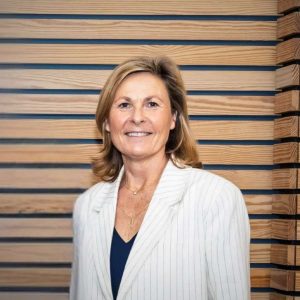
This week, we turn our attention to the province of Walloon Brabant. On 26 March, Mrs Laurence Rotthier was sworn in as a provincial councillor, handing over the mayoral sash to Mrs Virginie Hermans-Poncelet.
After more than twenty-five years of commitment at municipal level, she is now taking on a new challenge, which she approaches with calm and genuine curiosity. Interview.
Laurence, many congratulations on your new position! This is clearly the culmination of a long journey of political commitment at municipal level in Lasne: twelve years as alderwoman, then nearly fourteen years as mayor, and you have recently joined the provincial college, succeeding Mr Christophe Dister. Can you tell us about your journey?
Of course. I still remember the day I first pushed open the door of the town hall as an elected representative. I was so excited to discover my new responsibilities and actively take part in the life, management and future of my village. For twelve years, I had the privilege of being in charge of essential areas such as education, youth and the environment... Twelve years that taught me a great deal, both personally and professionally, about the complexity and richness of public administration. Then, in 2012, I was elected mayor. And I quickly realised that nothing truly prepares you for that role. No two days at the town hall were ever the same. There are projects coming to life, inaugurations, weddings, sporting and cultural events, village festivals... unforgettable historic moments such as the bicentenary of the Battle of Waterloo. There are also moments when, unfortunately, words are not enough, when you have to deal with floods, fires, serious accidents, the Covid crisis, the war in Ukraine and its consequences... And there are days when you have to make decisions that are not unanimous, that will not please everyone, but which you take on with responsibility. Over the years, I have seen my municipality evolve, grow and transform... Every day, I have remained true to myself, seeking to bring people together, to build connections, and to unite energies around shared projects and values.
Having led so many projects for Lasne, you are now taking over Mr Dister's responsibilities, namely education, sport, FormationBW, the Château d'Hélécine provincial estate and the chairmanship of the emergency services zone. Having started out as alderwoman for Education, this is in a way a lovely return to your roots. Can you tell us about your plans in that area and in your other responsibilities?
I am delighted to reconnect with my first love: education. It may still be a bit early to detail specific projects, but since taking office, I have begun a tour of the provincial schools to meet the management teams, teaching and technical staff, and to discover the facilities. Enseignement BW has more than 5,000 pupils spread across several establishments in Nivelles, Court-Saint-Étienne, Wavre, Tubize and Jodoigne. These visits have led to particularly rich exchanges and have allowed me to better understand secondary education, both transitional and above all vocational, which I was still not very familiar with. It is a real discovery. I now fully appreciate the richness and diversity of the options offered by provincial education, directly linked to the needs of our region. One of the projects will certainly be to pay particular attention to the revaluation of vocational streams and the image of Enseignement BW, in connection with the ongoing reforms. The aim will also be to help young people and their parents better understand that these streams offer real opportunities, including the chance to train with a view to setting up their own business.
I am also in charge of sport. As soon as I took office, I had the opportunity to attend the inauguration of the Wavre hockey stadium, of which the Province is a partner. This new facility is a wonderful asset. It will be a great opportunity for me to experience the 2026 World Cup up close, and also to showcase this sport through the various events organised around hockey.
I am also chair of the Walloon Brabant emergency services zone. This too is a great opportunity to continue my commitment to safety, in keeping with what I already achieved within the Mazerine police zone, where I already held the chairmanship. Finally, I am in charge of FormationBW and the Château d'Hélécine provincial estate, areas I am about to discover in the coming days.
Moving from managing a municipality to the daily management of a province must be quite impressive. In the context of the reform of the provinces initiated by the government, how do you approach the future on the eve of this reform?
Very calmly. Moving to a larger scale is certainly new, but as stimulating as it is challenging. I approach the reform as an opportunity to reaffirm the supra-municipal role of the Province. Any responsibility is of course potentially transferable, provided that the planned reorganisations bring real added value. From my experience as mayor, however, I note that certain reforms, particularly the mergers of police or emergency services zones, have not always generated the expected savings. This calls for approaching this reform with pragmatism and rigour.