
Ixelles is a dynamic municipality that combines cultural vibrancy, economic appeal and urban challenges.
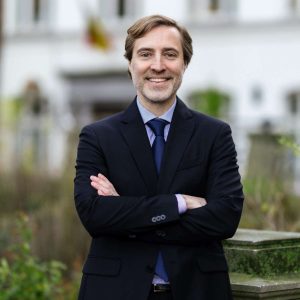
Gautier Calomne, First Alderman and Registrar, responsible among other things for the Economy, Education and Culture, looks back on his commitment, local issues and the projects he is driving to improve daily life for the people of Ixelles.
You have been active in politics for a long time, particularly within the MR. What led you to get involved in the local government of Ixelles? How do you look back on your journey so far?
Coming from a family of teachers and shopkeepers from Ixelles, my connection to Ixelles is both personal and natural. After studying law at the ULB, I chose to get involved in local politics, convinced that it is at this level that one can truly make a difference on issues that concretely affect people's lives.
And my connection with our party actually goes back to my student years! As President of the Federation of Liberal Students (2003-2006) and then of the Young MR (2007-2013), and later as a federal MP, I had the honour of championing our genuinely liberal convictions with strength, while also building a solid political and personal network within our party and beyond.
In Ixelles, I have been an elected representative since 2006. In 2024, surrounded by a young and dynamic team, I ran my best campaign yet. Today, as First Alderman and Registrar, I work daily to improve quality of life for the people of Ixelles. I want people to be able to say in 6 years: “with the MR, we saw the difference!”.
Ixelles is at once a cultural, commercial and residential hub, with very different realities from one neighbourhood to another. What do you see as the major challenges facing the municipality today? How do you intend to respond to them?
First of all, it is urgent to give a breather to those who work through a tax freeze! Taxes have risen too much in Ixelles in recent years.
Next, it is essential to quickly restore safety and cleanliness in every neighbourhood, and to implement mobility that respects both the environment and everyone's needs.
Finally, we need vision and ambition for Ixelles: build a favourable climate for the economic and commercial fabric, develop innovative, quality education for all our children, and make our rich and diverse cultural offering much more visible!
Of course, if we had an absolute majority, everything would be simpler. But that is not our situation. We therefore need to exchange views, discuss, debate and negotiate in order to set our agenda.
Ixelles is at the heart of the debate on mobility in Brussels. Between accessibility, urban design and the balance between pedestrians, cyclists and motorists, what is your vision for smoother, more harmonious mobility?
I have always been very clear: the car is set to take on a different place in the city, that is the direction of history. But that must not mean hounding motorists, as is too often the case! We need to strike a balance between pedestrians, cyclists, motorists and public transport users, with everyone having their place in an intelligently designed urban environment.
The revision of the Good Move plan, in consultation with all residents and shopkeepers, will be a key step in adapting measures to the real needs of the neighbourhoods. For that, we will need a fully functioning Government and a Minister for Mobility capable of listening.
It is also important to make access to commercial and residential areas easier, in particular by reviewing parking policy, in order to make the municipality more welcoming.
At the same time, improving the range and quality of public transport in Ixelles is also essential to make journeys even more efficient. Once again, I will need the support of the regional Ministers…
With lively neighbourhoods such as Matongé, Flagey and the European quarter, Ixelles is a nerve centre for commerce. What initiatives do you want to put in place to support shopkeepers and boost the municipality's economic appeal?
Ixelles is an economic hub that is active 24 hours a day: work by day, celebration by night. Our highly diverse neighbourhoods embody the living soul of our municipality. But our local shops, as everywhere else, face major challenges. At municipal level, we have solutions to offer.
To support our shopkeepers and strengthen Ixelles' economic appeal, from 2 June I will launch the first General Assembly of Commerce to listen to all self-employed workers and shopkeepers in Ixelles, identify their needs and, above all, build a roadmap for the future together. This initiative is accompanied by constant work on the ground in every neighbourhood, where we regularly meet shopkeepers to hear their views and continuously adapt our action to local realities.
My goal is clear: to make Ixelles THE commercial benchmark of our Region!
If you had to imagine Ixelles a decade from now, what major changes would you like to see happen? What impact would you like to have had on the municipality and its residents?
In ten years' time, I would like Ixelles to be recognised as a dynamic and attractive municipality, where quality of life, cultural excellence and economic growth reinforce one another. A municipality that knows how to leverage its strengths to shine well beyond its borders.
I want to modernise Ixelles this way, offering welcoming, safe and well-maintained public spaces where everyone can enjoy a pleasant and functional environment. A municipality where intelligent, attractive urban planning coexists with a thriving economic fabric, supported by a climate favourable to private initiatives, local shops and innovation.
I would like Ixelles to become a model of mobility and urban flow, with innovative solutions that concretely improve daily life for all residents.
Ixelles is a municipality rich in cultural life, with institutions such as the Théâtre Varia, the Théâtre de la Toison d'Or and Flagey. What place do you give culture in your vision for the municipality? How do you intend to support theatres, artists and cultural events to further strengthen Ixelles' creative identity?
As First Alderman, responsible among other things for Culture and Tourism, my ambition is to put Ixelles on the cultural map of Brussels, Belgium and the world. My cultural vision is highly ambitious and rests on three pillars.
First of all, I want Ixelles to shine well beyond its borders. With an exceptional Museum of Belgian Art, prestigious institutions such as Flagey, theatres, cinemas, renowned art galleries, but also a multitude of independent venues, artist collectives and creators who invent, experiment and push boundaries. I want to showcase this vibrancy, giving it the visibility it deserves to attract an ever wider audience, stimulate discerning cultural tourism and offer new opportunities to our artists. To make Ixelles an essential cultural hub, a natural destination for lovers of art and creation.
Furthermore, culture must also take root in the heart of every neighbourhood in Ixelles. Too often, art is seen as the preserve of a few specific venues, far removed from everyday life. I want to reverse this logic. Culture must be lived, shared and accessible to everyone, everywhere and at all times. It should unfold in public spaces, in places where life happens, appear around every street corner, and become a habit, a common thread between all the people of Ixelles.
Finally, I want to build bridges between culture and education, which also falls under my responsibilities. From a young age, every pupil schooled in Ixelles should be able to benefit from a basic cultural pathway to discover, experiment and grow. By giving children this privileged access to art, we nurture their curiosity, creativity and critical thinking. Strengthening the links between our municipal schools and Ixelles' cultural institutions means preparing the future of the next generations as well as possible.