
 Unacceptably long journey times, a shortage of drivers and a lack of training in children's specific needs: school transport for children with disabilities has long been a source of controversy. The MR proposes solutions.
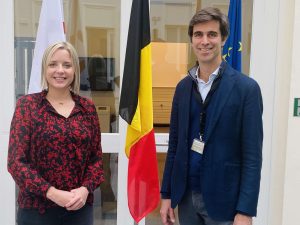
School inclusion also depends on school accessibility for children with disabilities. This issue concerns MR MPs Stéphanie Cortisse and Nicolas Janssens. They therefore questioned the French-speaking Minister for Education, Caroline Désir, and the Walloon Minister for Mobility, Philippe Henry, on the matter, as reported by the newspaper “L'Avenir”.
The issue of school transport is complex in Belgium, as it is linked both to the logic of the education networks set out in the School Pact Act of 29 May 1959 and to the fact that Belgium is made up of Regions and Communities. Moreover, school transport involves organising and managing a particular space-time framework, that is, a situation with specific spatial and temporal characteristics. It is therefore subject to a series of organisational, institutional and situational constraints. Finally, the diversity of stakeholders involved (SPW, TEC, COCOF, bus companies, independent drivers, etc.) further complicates matters.
The issue of school transport for children in special education is recurrent. The main complaint concerns the length of journeys. For example, nearly 50% of children using school transport to reach a school in Walloon Brabant spend more than two hours a day on the bus. And more than 20% spent over three, or even four hours, which is of course unacceptable for children. Not to mention the many children driven directly by their families to avoid such “mistreatment”. It is therefore unsurprising that absenteeism is particularly high in special education.
The school transport budget stands at €62.4 million. At the last budget conclave, the Walloon Government allocated an additional budget of over €11 million for 2024, on top of the recurring €1 million grant aimed at reducing excessively long journey times, particularly in special education. Questioned by Stéphanie Cortisse and Nicolas Janssens, the two ministers stated that reducing school transport journey times is a real challenge, as it involves matching significant transport demand to specific establishments, two-thirds intended for special education pupils, scattered across Walloon territory, while taking into account the significant shortage of drivers. Minister Désir regrets the length of the journeys but feels powerless, as the regional authorities hold competence in this area and the Wallonia-Brussels Federation only takes part in the various school transport committees as an invited member. Minister Henry adds that the new public service contract with the Opérateur de Transport de Wallonie (OTW) for 2024-28 includes journey time as a quality indicator, setting an attention threshold of 3 hours per day.
Regarding the driver shortage, Minister Désir sees the activation of flexi-jobs as a possible solution. Wallonia is also working to recruit drivers through Job Days.
For MR MPs, these responses are insufficient. The MR wants a single dedicated unit for school transport to be created within the administration. Improving transport also requires recruiting and training new escorts and drivers, as well as better communication with users.
It is important to objectively assess needs with a view to producing a survey clearly identifying the areas requiring additional resources to improve school transport provision for special education pupils;
The MR is also calling for a genuine legal cap on the maximum actual round-trip journey time, also taking distance into account, concrete measures to recruit drivers and escorts, workforce stabilisation, and enhanced training for escorts in caring for these pupils with specific needs.
The MR also proposes considering the use of vans/minibuses where possible, which would make it easier to recruit drivers, and finding other duties for drivers for the rest of the day (in hospitals, specialised institutions, etc.), to address the issue of precarious contracts/few hours. It would also be worthwhile allowing these minibuses to use bus/taxi lanes (in major cities).