
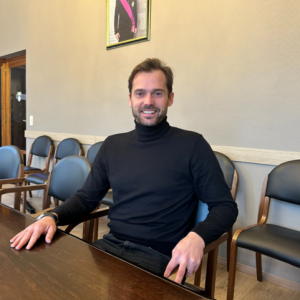
Geer, located in the province of Liège, is a municipality rich in historical and cultural heritage. Since 2024, Pierre-Philippe Dumont, affiliated with the MR, has been its mayor, succeeding Dominique Servais. The “Intérêts Communaux” (IC) list, in place since 1976, continues to lead the municipality, reflecting notable political stability.
Beyond his political commitment, Pierre-Philippe Dumont is known for his local involvement and his determination to revitalise Geer while preserving its identity.
Can you tell us about your personal journey and the motivations that led you to get involved in politics, eventually becoming mayor of Geer?
I got into politics in 2018. I'm a Geer native, and so is my family (my great-grandparents already lived in the villages that make up the municipality). I've been a member of the MR (then PRL-MDF-MCC) since the early 2000s. I always followed politics closely, and it seemed clear to me that one day I would get involved at local level, given my roots and my interest in what I'd call “local management” at municipal level. I was first informally approached within the IC group. That got me thinking, and in September 2017 I contacted the chairman of the MR local branch in Geer to put myself forward as MR candidate within the IC group. Result: I was alderman for Finance and Education from 2018 to 2024, and now I'm Mayor, with the same responsibilities plus those of the office itself.
On a more personal note, I studied physical education and physiotherapy, then taught in secondary school, before ending up at HEPL as director of the education department. That's actually why I was particularly interested in the Education portfolio at the municipality, one I wanted to keep.
I'm married to Séverine and we have two boys, aged 16 and 13. My family and loved ones are very important to me, as they help me keep my balance.
My wife is the one most affected by politics, which takes time away from my personal life. I thank her for her understanding and her support, which has always been there.
Geer has a political history marked by the presence of the “Intérêts Communaux” (IC) list since 1976. How do you explain this longevity, and how do you see Geer's political future in the coming years?
Our slogan has been a variation on the word CONCRETE across several campaigns (“Soyons concrets” in 2012, “Restons concrets” in 2018 and “Toujours concrets” in 2024). We also have 3 words that define our action: closeness, listening and work.
Closeness is self-evident at municipal level, but it must translate into practice, and our political action must respond to local needs.
Listening enables us to adapt and refine our procedures, and to stay in touch with citizens, their interests and their expectations.
Work, because it's through work that we move forward, become independent and see projects through. The MR has become the only true party of work in the noble sense of the term, and that's what characterises us within the IC group in Geer. In a rural setting like ours, there's nowhere to hide, and you have to roll up your sleeves to make progress.
As for the future, we've been preparing it since 1976 by delivering on our election promises, which become… concrete. I believe citizens aren't fooled, and are in fact more pragmatic than we think. They recognise themselves in our policies and our actions, and reward us for it at the ballot box.
Personally, I don't make promises just to please people. When a request isn't realistic or feasible, I say so straight away. I'm Mayor after serving one term as alderman, and I hope to continue, but what matters most to me is ensuring the lasting continuity of our majority and our group. It's a responsibility I fully appreciate.
What are the main challenges you want to tackle during your term to improve the quality of life for the people of Geer?
Like many others, we have to deal with changing climate and rainfall conditions. Managing mudslides is a priority. After only 4 months in office, and while respecting the timeframes inherent to public procurement, we are starting improvement works in several villages to contain the phenomenon.
We need to carry out two projects related to education and early childhood: extending the primary school and creating a new nursery to replace the existing buildings, which are no longer suitable.
On the economic front, together with a private partner, we're working on converting an abandoned industrial site (a former sugar refinery) to establish a semi-industrial business park for SMEs combined with rural housing.
All this in addition to projects that recur from term to term and fall under municipal management (road maintenance and renovation, equipment investment), while maintaining financial balance. Our municipality is, and must remain, a place where the tax burden is minimal.
Geer has a rich cultural heritage, including the five Omal tumuli. How do you plan to make the most of these assets to strengthen the municipality's cultural identity?
This site is neither the best known nor the most accessible, even though it bears witness to the past and to the ancestral settlement of our territory. We are fortunate to have a site and ruins of a 17e-century manor along the Geer (a river that rises in Lens-Saint-Servais, a village in the municipality). The “Balade du Geer” is a walking route also accessible by bike, which follows the watercourse and crosses the municipality near the Haut-Geer nature reserve (RNHG). This reserve is a bird sanctuary that preserves fauna and flora respectfully along the former settling ponds of the old sugar refinery. The management of this heritage is a PPP between the municipality, Natagora and an industrial company active in the municipality. It is our green backbone, combining economy and ecology. In our view, there is no ecology without economy.
The second pillar of our cultural policy revolves around the Salle de la Liberté (located on the square of the same name), the focal point of numerous activities (theatre, exhibitions, activities for young people and seniors, various fairs and local festivities). This site is complemented by a library run by municipal staff and volunteers, which keeps expanding its activities and initiatives.
Geer has plenty to offer visitors. What places or cultural events would you recommend to someone wanting to discover Geer? Are there any ongoing initiatives to promote local tourism?
The municipality of Geer boasts a rich cultural and historical heritage, reflecting its rural past and its commitment to preserving its emblematic sites. Its architectural and historical heritage includes the Château de Boëlhe, the ruins of the Château de Hollogne-sur-Geer, the Saint-Brice church of Hollogne-sur-Geer, the Chapel of the Crucifix of Hollogne-sur-Geer, the Chapel of Notre-Dame de Lourdes of Ligney, the castle mill and the castle brewery of Hollogne-sur-Geer.
Its natural heritage and cultural trails include the Haut-Geer nature reserve and the Promenade du Geer.
Our country roads are also well suited to walking or cycling. The rather flat terrain of Hesbaye is accessible to everyone. Along these routes, you can discover the typical setting of the Hesbaye villages with their square farmhouses.
The municipality of Geer, in collaboration with the Local Development Agency (ADL) of Berloz-Donceel-Faimes-Geer, is actively committed to promoting its heritage and developing tourism. Accommodation options are constantly growing, the built and natural landscape heritage is highly varied, local producers are numerous, and a wide range of events is regularly organised.