
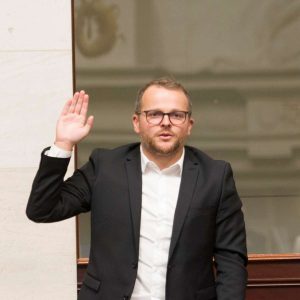
This week we head to Neupré, where we meet MP and alderman Mathieu Bihet, a well-known personality to all.
He first tells us about his work at local level, in his flower-decked municipality of Neupré, before discussing his commitment within the MR.
Mathieu, you are an outgoing federal MP and candidate for the first substitute seat on the MR list for the Chamber in Liège. What is your track record and what are the new challenges?
First of all, regarding my track record, I sat on the Parliament's energy committee. I worked directly with my colleague Marie-Christine Marghem on extending nuclear power. That will remain a very memorable moment.
As for the challenges, I believe the next term will focus on two closely linked issues: the necessary tax reform, which overall must result in lower taxation, and labour market reform. I said as much before my return to parliament in an interview with L'Echo: the cost of labour is part of the debate on purchasing power. A pay rise cannot happen for a worker if the cost to the employer equals three times what the worker would receive.
These topics are linked.
You have been alderman since 2017, following a motion of no confidence that brought the liberals back to power in Neupré, with Virginie Defrang as mayor. The 2018 election confirmed the good health of the local MR. What is the recipe behind the MR's strong performance in Neupré?
As a reminder, in 2012 we were already the leading political force in Neupré, but a coalition of losers was renewed anyway. The MR's return to power after more than 15 years in opposition came after very strong tension within the majority over a planning issue. I think this dimension shouldn't be underestimated in a small rural municipality like ours. People move to Neupré for a pleasant, green living environment, not to be part of a new urban extension.
In addition to this genuine spatial planning policy, we optimised our spending to be able to lower taxation. We also launched a great many initiatives to improve residents' daily lives, whether in terms of municipal facilities or the range of activities offered by the municipality.
On a more personal level, your closeness to the residents of Neupré is well known. Which issues do you focus on in particular, and which are you most proud of?
I am in charge of territorial, rural and economic development. Among the actions or projects I have successfully carried out and am quite proud of is, for example, the introduction of installation grants to bring businesses back to village centres. We have also set up an environmental plan for the entire term aimed at greening the municipality and introducing a whole range of measures to protect biodiversity and improve residents' living environment. It's important for us to show that there is a path to a positive, non-punitive ecology, unlike what the greens propose.
Alongside this local commitment, you are also the MR's general delegate. Can you tell us specifically what this role involves?
The role of general delegate is a hybrid one. Internally, I first of all put people in contact and ensure information flows between the party's various levels (parliamentary groups, cabinets, etc.). It's important that information circulates and people talk to each other, especially when we want to launch new proposals, which I sometimes put forward myself. Externally, I act as a spokesperson and party representative. I also sometimes meet civil society representatives, act as a link with the party, or serve as an entry point for actors “outside” politics who wish to meet one of our elected officials.
You sit on behalf of the MR on the board of the Union of Cities and Municipalities, chaired by our friend Maxime Daye. How does that work? What are the major topics discussed? Do you feel the UVCW is useful to municipalities?
First of all, local authorities have proven their importance, expertise and agility during the difficult times we have just been through. The UVCW plays a central role in this respect in coordination and information exchange. However, and this is probably true for other levels of government too, local authorities' finances are under severe strain. Financially healthy municipalities are starting to worry, and municipalities that already had great difficulty making ends meet are now clearly underwater. One example deepening the shortfall: the funding of municipal staff pensions. For this, the UVCW clearly plays a role representing local authorities in sector meetings or ministerial cabinets. At this stage, I would even say the UVCW is indispensable in this regard.