
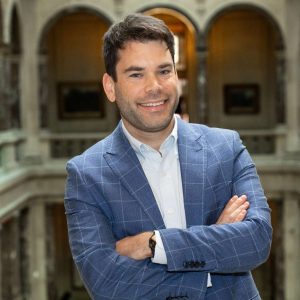
Elected alderman in Schaerbeek after the 2024 local elections, Martin de Brabant was not yet 34 when Audrey Henry's appointment as regional Secretary of State propelled him to the head of the “City of Donkeys”. A meteoric political rise for this Schaerbeek native, who chose to leave the investment company where he worked to devote himself fully to his municipality. A new chapter is opening for him, and for Schaerbeek.
You are the new mayor of Schaerbeek, can you introduce yourself briefly: your background, what brought you into politics and why Schaerbeek?
I am 34, a lawyer by training, and I have been in politics for 14 years now. I started in Rochefort, where I was active for about ten years. At the same time, I spent three years working in François Bellot's cabinet, when he was in charge of Mobility in the federal government.
I then worked for six years at an investment company, the Federal Holding and Investment Company. I resigned in 2022 to move to Schaerbeek.
At the last regional and local elections, I chose to re-enter politics. I was appointed alderman in Schaerbeek after a major political crisis, before being called upon today to take on the role of mayor.
I am a Schaerbeek resident by choice. I believe I represent a whole generation of people who came from Wallonia, or elsewhere, and chose Brussels to build a life, thrive and get fully involved.
I didn't go into politics to criticise, but to build. Today, as mayor, I am very present on the ground. But Schaerbeek is a demanding, lively and complex municipality.
I have a short two-year term in a plural majority. My commitment is to give my best and to practise politics with decency.
The North Station district is a burning issue, caught between insecurity, drug trafficking and urban renewal works. What new impetus do you want to give it, and with what concrete levers?
The North district is one of the key issues to which I want to give momentum.
The situation is very worrying, we shouldn't deny it. But we shouldn't caricature it either: it's an extremely lively district, with real energy, but where the challenges are significant.
What we are doing today is acting on several levers at the same time. Because a multifaceted problem requires a multifaceted response.
First of all, security: more police presence, greater use of public space, and closer coordination with other municipalities and regional services. It is within this framework that I am continuing Audrey Henry's work, notably through night-time closures of publicly accessible premises, increased police presence, area exclusion orders, and more cameras.
Then prevention: we won't solve these situations through repression alone. We are strengthening social outreach, working with associations, and supporting the most vulnerable groups.
Finally, the living environment: cleanliness, urban design, regulation of certain uses. Because a district where people live better is a district that changes for the long term.
And above all, these decisions don't come from above. They are the result of in-depth work carried out with local stakeholders: residents, shopkeepers, associations, police services, social workers. We listen, we analyse, and then we act.
But we also have to be clear: the municipality can't do everything.
Everyone must play their part. The Region has announced a €10 million station plan. Works on metro line 3 left a street derelict, which Beliris will restore. At federal level, Bernard Quintin has promised to recalculate the police zone funding law and to fight drug trafficking.
You became mayor following Audrey Henry's appointment to the Brussels government, as part of an agreement providing for the mayorship to pass to the PS in 2028. How do you see these two years, and how do you view this agreement?
I'm not thinking in terms of a transition, I am fully committed.
Two years is short, but it's more than enough to make an impact: being on the ground, deciding quickly, working with the teams, and above all keeping commitments.
The political agreement exists, it's well known. After these two years, I will become chairman of the CPAS while remaining a member of the college.
But that's not the point today. I want these two years to be useful: to make progress on issues, improve daily life, and restore trust.
I'm not champing at the bit politically. I have two years to make progress, and my personal future is not the question.
In two years, you will hand back the mayoral sash. What do you want to have achieved for Schaerbeek, and what do you want Schaerbeek residents to remember about your time leading the municipality?
If in two years, Schaerbeek residents say their municipality is better maintained, cleaner, safer, clearer… then we will have succeeded.
I want to be consistent with what I say and with the way I've carried out this mandate from the start: being present, accessible, working hard, and not shying away from difficult issues.
And above all, someone who has never forgotten that behind every issue, there are people.