

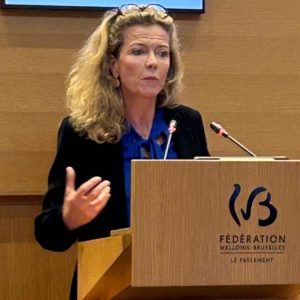
 Tuesday 8 September, in the Equal Opportunities committee of the Parliament of the Wallonia-Brussels Federation, MR MP Clémentine Barzin questioned Minister Yves Coppieters about Unia's response in the Sophie Straat affair. The singer had caused controversy during the Ghent festival by urging white men to move to the back of the audience, a scene that led to hundreds of reports being filed with the organisation. The liberal MP invited the minister to seek answers from Unia regarding the exclusion phenomena linked to wokeism.
“All white men, to the back! This is the moment for girls, queer people and people of colour. No time for nuance: we are already far too late, for a long time, too late for nuance. All white men to the back, white men to the back!”, singer Sophie Straat had chanted during a concert in Ghent.
These remarks sparked strong reactions in public opinion, and many people found these statements hurtful, stigmatising or polarising. This was clearly not the artist's first attempt at this, as a similar call had already taken place during a concert in the Netherlands.
For its part, Unia, the Interfederal Centre for Equal Opportunities and the fight against racism and discrimination, received around a hundred reports in this case. Its co-leadership stated in a press release that there was not “sufficient evidence to conclude that there was a breach of anti-discrimination legislation or punishable incitement to hatred”.
This argument struck MR MP Clémentine Barzin, who asked Minister Yves Coppieters for his assessment of Unia's opinion, questioning the signal sent by this type of scene, given that the Wallonia-Brussels Federation is committed to citizenship education, memory work and the prevention of all forms of discrimination.
In his reply, the Community Minister for Equal Opportunities stressed Unia's independence as well as the importance of nuance, including in the education of young people.
While agreeing with this, the liberal MP nonetheless invited the minister to go further and request that the equality institute reflect on wokeism and the exclusions it can produce.
“Organising public and cultural space according to criteria of skin colour, such as ordering part of the audience to stand at the back of a venue based on their appearance, is not an isolated incident. It is the concrete manifestation of a dogmatic school of thought that claims to fight discrimination by reinventing it. This is what we now call wokeism”, declared Clémentine Barzin in the Equal Opportunities committee.
“How did the so-called white young people feel, rejected for what they are and not at all for their individual actions? Did they not feel stigmatised, humiliated? How would Unia have reacted if the singer had, conversely, targeted young women of colour? Whatever the artist's stated intention, whether to denounce past injustices or to create so-called “safe” spaces, racism remains racism, even when it claims to be deployed for “good reasons”. By accepting the sorting of an audience according to racial criteria, we legitimise a historic tool of exclusion and sabotage the fundamental universalist achievements of equality before the law.”
For Clémentine Barzin, Unia cannot remain silent on this phenomenon. “Wokeism has its own history and characteristics, but today, since it produces exclusions, it is important that Unia addresses it; it is also a matter of social cohesion”, the MP concluded.