
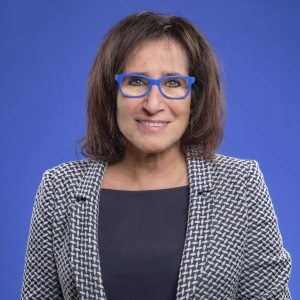
Since 9 June, things have been moving fast for our co-opted senator, Viviane Teitelbaum. First elected vice-president of the Belgian delegation to the NATO Parliamentary Assembly, she has just been appointed president of the Network of Women Parliamentarians of the Francophonie.
Let's start with your election as vice-president of the Belgian delegation to the NATO Parliamentary Assembly. Can you explain what this involves and what your role is?
Since its creation in 1955, the NATO Parliamentary Assembly (NATO PA) has given parliamentarians from the Atlantic Alliance's member states the opportunity to debate security issues and influence decisions on them. The NATO PA is made up of 281 parliamentarians from the 32 NATO member states.
The Belgian delegation is made up of 13 members (full and alternate) from the Chamber and the Senate. My role as vice-president of the Belgian delegation will involve standing in for the President, Théo Francken, in his absence on the standing committee. This role will also allow me to lead certain debates within our delegation in order to reach a common position for our country ahead of the working sessions, which take place twice a year.
Furthermore, as a member of the Committee on Democracy and Security, I will be able to work, in a different setting, on issues that have long been close to my heart.
Such as taking gender into account in the defence and security sector; mechanisms for democratic oversight, civil liberties, fundamental freedoms, the role of religion in security matters, as well as strategies to combat radicalism and violent extremism; protecting civilian populations from threats of terrorism and weapons of mass destruction, the challenges linked to refugees and migration flows; human rights and the protection of minorities; the consequences of terrorist attacks and the impact of counter-terrorism efforts on civil liberties and human rights; international humanitarian law and the protection of civilians, particularly women and children, in armed conflicts, as well as developments in international criminal justice; “indirect security threats”, such as piracy, cyber-attacks, organised crime, arms and drug trafficking, and human trafficking.
You have been appointed president of the Network of Women Parliamentarians of the Parliamentary Assembly of the Francophonie. What are the goals of this network, and what will be your main priorities during this term?
I am very proud to hold this position, in keeping with my long-standing feminist commitment.
The network's aim is to promote greater participation by women in political, economic, social and cultural life, both here and across the wider French-speaking world.
It is also about fostering solidarity among women parliamentarians through the exchange of good practices, as well as training and legislative frameworks that have already been developed, such as gender-sensitive budgeting or a policy framework on harassment, which is still far too common in parliaments and acts as a brake on the participation of elected women, as well as of female staff in administrations and cabinets. A striking figure: 82% of women parliamentarians in the Francophonie are said to have already experienced psychological violence in the course of their mandate!
I have many ideas, because the network is a formidable lever for advancing women's rights and equality, but I will start by consulting my colleagues to build a participatory dynamic. In 2025, I will in any case propose an evaluation of the implementation of the Beijing Declaration and Platform for Action and how to move the objectives forward.
In the midst of all this, you are also a municipal councillor in Ixelles and are leading the list in the elections on 13 October. What are the main concerns of the people of Ixelles, and what solutions does the MR & vld list propose?
I would say that the current priorities for the people of Ixelles and the MR-Vld are improving the management of municipal finances, safety and cleanliness.
Over the last six years, taxes and levies have risen by 30.66%! Property tax rose by 56.49%, personal income tax by 27.68%, and the municipality has lined its pockets to the tune of 22 million euros thanks to fines linked to the Limited Access Zone on Chaussée d'Ixelles, that's €11,000 a day! This is unacceptable. As alderwoman for finance, I had brought the budget back into balance, and the College had reduced spending while introducing the first gender-sensitive municipal budget. It's not easy, but it's a matter of respect.
Those who live in Ixelles must be able to stay there without being crushed by taxes and levies, and with greater purchasing power. We need to put our public finances back in order, stop unnecessary spending and give the people of Ixelles some fiscal breathing room by lowering taxes and parking charges.
Safety is the second challenge. Our municipality is not the only one affected, but laxity has caused damage both to residents and to businesses. Whether it's no-go zones, tolerance of petty crime or a lack of penalties. We want a stronger neighbourhood police presence, zero tolerance for drug trafficking and absolute safety in public spaces for everyone, particularly for women, LGBTQIA+ people, and all those exposed to violence or harassment. Safety is the first of all freedoms.
Finally, priority must be given to restoring cleanliness and beauty to our streets. Ixelles is dirty. We need local and regional reform that takes into account the specific character of each neighbourhood, but also tougher penalties so that graffiti, bins left out on the wrong days or times, and other forms of anti-social behaviour are properly punished. Again, it's a matter of respect for residents and for the work of cleaning staff.
To finish, let's stay local: what are the must-see spots for a day out in Ixelles?
Ixelles is a special municipality. We're lucky enough to have everything within our borders! Museums, including the well-known Ixelles Museum and the children's museum, an academy, a university campus, the school of architecture, theatres and Flagey for the finest concerts, a European parliament, a swimming pool, French- and Dutch-speaking schools, a sports centre, the region's second-largest shopping district, markets almost every day, and a listed cemetery. You can party there or take a quiet stroll through residential neighbourhoods or around the ponds. A day in Ixelles can therefore take many different forms, with touches of different languages and cultures.