
Faced with a budgetary emergency inherited from the wasteful policies of the past, the MR is taking responsibility and committing to getting Belgium back on track. It is clear that the work must focus on reducing spending rather than raising taxes – Belgium being one of the most heavily taxed countries in the world. But reducing spending alone is not enough: we must restore economic growth by continuing our reforms to lower taxation, bring people back to work and make the labour market more flexible.
The various governments of the country have inherited a particularly alarming budgetary situation:
– In 2025, Belgium recorded the worst budget deficit in the entire European Union (5.1% of GDP). In other words, the State spent €33 billion more than it earned.
– These deficits are leading to a considerable rise in debt. Past policies have led to debt exceeding 100% of GDP – one of the worst in the European Union – after Greece, Italy and France. Today, every Belgian carries €60,000 of public debt – that is colossal.
– Because of this debt, the federal State will pay out more than €12 billion in interest charges – that is 4 times the budget of the FPS Justice!
Reducing the deficit means reducing debt and therefore interest charges. Since 2002, State revenues have grown at the same pace as the wealth created, while expenditure has spiralled out of control.
Belgium is the third European country with the highest tax burden: this is clear proof that the problem does not lie with revenues but with spending.
This is why the MR places control of public spending at the heart of its project. The goal is to do better with less – and this is not unrealistic: a country like Denmark, known for its exemplary social security system, manages to generate budget surpluses! Thanks to the MR, the country's governments are working to streamline State structures (we do not accept that Belgium has 26 political office-holders per 10,000 inhabitants, compared to 5 in Denmark), to get people back into work, and to reform public services.
Unlike the left, the MR is convinced that economic growth is essential: it guarantees healthy public finances, the well-being of the population, a strong labour market, and more consumption and investment.
Since the start of the legislature, the MR has been pushing ahead with its reforms:
– Lowering taxation on work to boost purchasing power and increase the income gap between benefit recipients and workers.
– Reducing regulatory and administrative burdens, notably through Minister Simonet's SME Plan.
– Increasing the employment rate, notably through measures to bring long-term sick people who are able back into work.
– Focusing efforts on high value-added sectors where Belgium excels, notably through the identification of the 5 Strategic Innovation Domains.
1. Belgium is facing a budgetary emergency
• The current governments have inherited a worrying situation: in 2025, Belgium recorded the worst budget deficit in the entire European Union (5.1% of GDP). In other words, the State spends €33 billion more than it earns – that is colossal. For comparison, a country with a comparable social security system and tax burden, Denmark, posted a budget surplus.
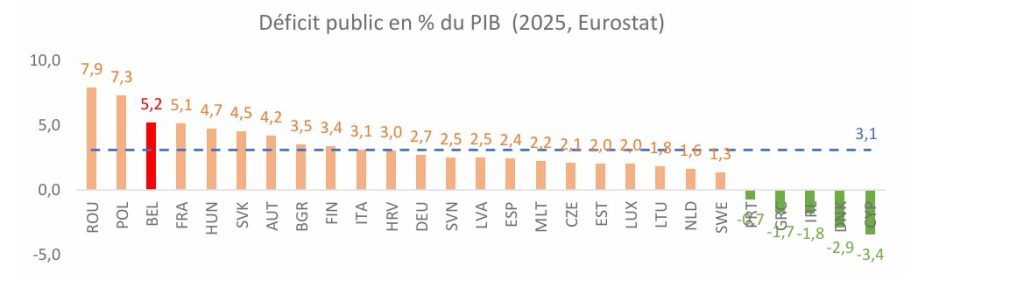
• This situation leads to a debt level that is far too high for our country: 107.9% of GDP in 2025. The only countries doing worse are Greece, Italy and France. For comparison, Denmark's debt stands at only 27.9% of its GDP.
• In concrete terms, here is what public debt weighs per inhabitant:
– Belgium: €60,000 per inhabitant,
– Denmark: €20,000 per inhabitant.
• Our abysmal debt has very concrete effects: in 2026, the federal State will pay €12.5 billion in interest charges – that is equivalent to 4 times the budget of the FPS Justice!
• Belgium is the third European state with the highest tax burden, yet we have the worst deficit. The conclusion is clear: we must not raise more taxes, we must seriously control our spending – and indeed, we have already done so in the past!
2. Evolution of State revenues and expenditure
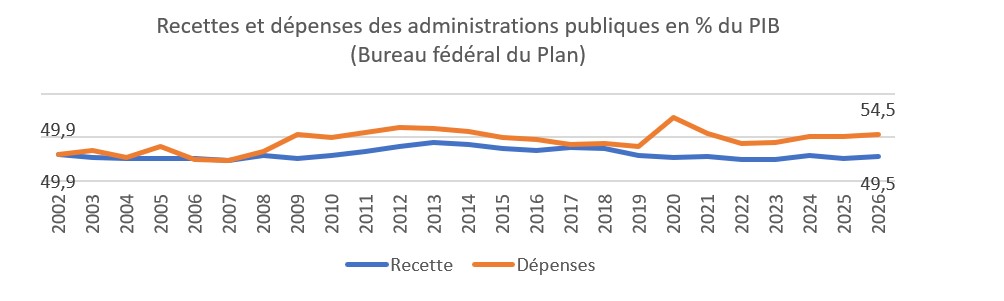
• While the State's accounts were balanced in 2002 (revenues and expenditure at 49.9% of GDP), the situation has continued to deteriorate. In 2026, expenditure will represent 5% more of GDP than revenues.
• Revenues as a % of GDP are almost identical between 2002 and 2026: this is a normal situation, State revenues have grown at the same pace as GDP – that is, as the wealth created.
• Expenditure, on the other hand, will represent 54.5% of GDP in 2026, which is 4.6% more than in 2002. The conclusion is clear: spending has grown much faster than newly created wealth.
• Spending rose sharply during the 2008 and 2020 crises – but it never returned to its pre-crisis level. Denmark, for example, managed to reduce its spending once the crisis had passed. In Belgium, we must show the same courage.
• Worse still, Belgium has spent particularly badly: in Europe, 16 countries spend less for a better quality of public policy. Denmark, once again, stands out for the best quality in the whole European class!
• It is self-evident, we must cut our spending! We can achieve more by spending less! Denmark proves it: it is possible to reduce spending while guaranteeing a remarkable quality of life.
3. Debt and interest charges
• The deficits recorded so far have caused debt to explode – indeed, to maintain out-of-control spending, the State has had to borrow massively.
• This high level of debt is causing interest charges to spiral out of control – through two mechanisms:
– First, as the stock of debt increases, interest charges have mechanically jumped.
– Second, the legacy of these deficits and this high debt undermines the confidence of financial markets ➡️ interest rates rise: the Belgian ten-year rate reaches a peak of 4%, compared to 3.4% in Germany.
• These high interest charges pose a significant problem:
– First, these charges prevent the State from using this money to pursue its policies. For example, the federal State will spend around €12.5 billion on interest charges in 2026. This amount is equivalent to 4 times the budget of the FPS Justice. If we do nothing, interest charges will rise to €18.6 billion in 2029, an increase of 49% in 3 years!
– Second, these charges bring us closer to the “snowball effect”: if the interest rate on debt is higher than the GDP growth rate, then debt increases mechanically, even without a primary deficit.
• Reducing spending➡️reducing debt➡️reducing interest charges➡️freeing up resources for ambitious policies!
4. How to address the deficit and control the growth of debt
• Since the federal and regional governments took office, the MR has made it a point of honour to reduce the deficit inherited from past policies. The goal is clear: without strong action, the State will be even more strangled by interest charges. In the worst case, financial markets could even refuse to lend additional funds.
• We refuse to give in to fatalism, we work every day to implement ambitious reforms to safeguard a social security system worthy of the name and to free up resources for new policies!
• To address the deficit, we must:
– Reduce spending,
– Accelerate GDP growth.
• Today it is clear that we must reduce spending and accelerate growth:
– Increasing revenues, as the left wants to do, means more taxes and taxing working people even more. This is out of the question for the MR. Belgium is the 3rd European state with the highest tax burden (as a % of GDP) – we can hardly do 'better'. On the contrary, we must cut taxes. And quickly.

But worse still, it is an easy solution that would slow the growth of our businesses and the purchasing power of our households. For the Mouvement Réformateur, this is a red line: we refuse to fund a bloated and inefficient State by taking even more out of Belgians' pockets.
The left will argue that taxing the wealthiest is the solution – forgetting that, according to the European Commission, revenues as a % of GDP from the various wealth taxes in Belgium are the highest on the continent!
– Reducing spending has become a necessity – primarily to sustain our social security system and to free up resources for ambitious policies. It is necessary to:
– Control the growth of healthcare spending by focusing on greater efficiency – according to the IMF, savings of 20% to 30% are possible! That is why we are making the reintegration into work of long-term sick people who are able a priority.
– Reduce and optimise the number of public structures and their staff – a study showed that implementing AI in public services in the Netherlands would generate a 20% efficiency gain!
– Simplify the structure of the State – how can it be explained that Belgium has 26 political office-holders per 10,000 inhabitants compared to 5 in Denmark? That is why the MR is actively working on concrete reforms: abolishing the Senate, abolishing the Provinces, merging municipalities. Our goal is to simplify the structure of the State in order to generate synergies and increase the efficiency of public policy.
– Accelerating GDP growth must be at the heart of every political project.
– Lower the tax burden to boost consumption and investment,
– Reduce the size of the State – there is a strong negative correlation between the size of the State and economic growth,
– Increase the private employment rate so everyone can fulfil their potential,
– Reduce administrative procedures that hold back businesses,
– Improve the confidence of businesses and entrepreneurs,
– Invest in innovation, one of our country's key strengths,
– Improve our companies' access to financing.
5. GDP growth in perspective
• The global geopolitical context is weighing heavily on Belgian economic growth: it is almost at a standstill. It is therefore urgent to act and to put economic growth back at the centre of our political project!
• Here is the evolution of real (inflation-adjusted) economic growth for Belgium:
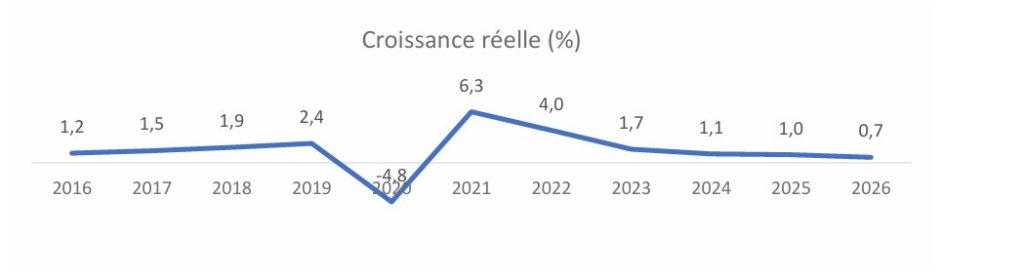
• The forecasts for 2026 are worrying: the Belgian economy is expected to grow by only 0.7%. The conflicts in Ukraine and the Middle East have worsened growth prospects: in February, the Federal Planning Bureau was expecting growth of 1.1% for 2026.
• Despite the context, we cannot afford a recession and must do everything to free those who create wealth!
6. Why it is necessary to restore strong economic growth
• First of all, growing GDP by 0.5% improves the federal State's finances by €1.5 billion. We must ensure that this amount is reinvested in the economy, in the efficiency of public services and in social protection.
• Above all, economic growth is the main driver of wealth and well-being in a State. It is essential to maximise this growth.
• Economic growth is a key indicator of prosperity: average incomes rise, leading to greater well-being, more consumption and a better quality of life. Moreover, growth is directly linked to job creation – which in turn enables more growth. In short, it's a virtuous circle!
• Economic growth is directly correlated with job creation, which in turn allows for more growth: it's a virtuous circle!
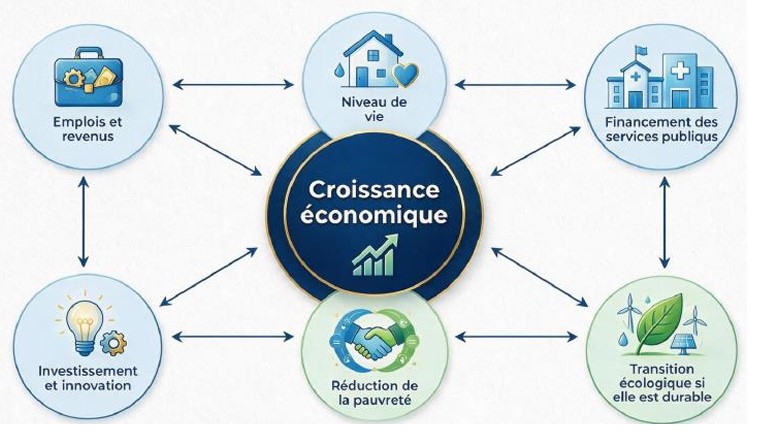
• Finally, an increase in GDP through growth mechanically improves indicators such as the deficit/GDP ratio and debt levels. These are not just figures: debt falling from 100% to 80% of GDP clearly shows that public authorities can rely on a stronger economy to face creditors.
7. What are the ingredients of growth
• LOWER TAXATION: this is a major element of competitiveness. For businesses, labour costs are the most important issue. Belgium is one of the most heavily taxed countries in the world: which company would set up in a country where charges are higher than elsewhere?
– Lowering taxation on labour and businesses is not a dogma – it is a necessary condition for economic vitality! That is why, thanks to the MR, a series of tax-reduction measures have been taken – notably the progressive increase of the tax-free allowance from €10,910 to €15,600 by 2030.
• SHRINK THE SIZE OF THE STATE: there is a strong negative correlation between the size of the state and economic growth. Belgium, with 54.2% of public spending as a % of GDP, is particularly affected – we are the 4th biggest spender in the European Union.
– We are reforming the structures of the state (Senate, provinces, municipalities) and focusing on better efficiency of public services, without replacing every civil servant.
• INCREASE THE EMPLOYMENT RATE: economic growth generates job creation. But the reverse is also true. Our employment rate is significantly below the European average, which weighs heavily on our economic vitality. That is why getting people (back) into work must be a priority of our policy!
– Thanks to the MR and our reforms, the income gap between a worker and a benefit recipient will significantly increase. We are also working on returning long-term sick people who are able to work – we even want to go further in their support and monitoring.
• REDUCE ADMINISTRATIVE AND REGULATORY BURDENS: for businesses and entrepreneurs, these burdens are the second most important challenge. The regulatory inflation we are experiencing forces companies to devote considerable time and money without generating any added value! We must urgently reduce rules and related obligations. At every level of power, from European to local, simplification must be our compass.
– At the federal level, a series of measures have already been approved: notably through Minister Simonet's SME Plan, which focuses heavily on concrete administrative simplification measures.
• INCREASE BUSINESS CONFIDENCE: the correlation between the confidence index and growth is almost perfect! This confidence is not just a given, it must be improved: through political discourse, through the regulatory framework, through taxation. It is essential to provide a clear and consistent framework for those who create economic value!
• INVEST IN INNOVATION: Belgium is a country recognised for its research and for the high-value-added sectors that depend on it: biotechnology, pharmaceuticals, digital. Tax and regulatory incentives must be put in place so that we build on our greatest strengths!
– At the Walloon level, Minister Jeholet consulted the Walloon economic fabric and identified 5 Strategic Innovation Areas on which concrete and significant efforts will be focused.
• IMPROVE ACCESS TO FINANCING: European companies in general, and Belgian ones in particular, struggle with access to financing even as hundreds of billions of euros sit idle in bank accounts earning low returns – this is a major obstacle to the growth of our businesses. To solve this problem, it is essential to (i) invest in financial education in our schools, (ii) establish encouraging legislative and tax frameworks, (iii) popularise financing vehicles for unlisted companies. Our businesses must be able to benefit from funds that households do not dare or cannot invest!