
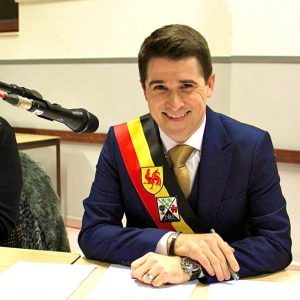
At 36, Jérôme Cochart is Blegny's first liberal mayor. Indeed, last October, after more than 47 years in power, the PS was sent into opposition.
You were a candidate on the list led by Diana Nikolic for the June election and lead candidate in the October municipal elections. A year of campaigning is a very intense human experience, which you combined with your profession as a lawyer. If you had to name one thing you learned this year, what would it be?
It's true that it was an intense year with two election campaigns back to back. But once the elections are over, especially when you achieve results like these, you feel proud of the work accomplished, and what remains are the memories and the friendships forged along the way.
That said, I admit it wasn't always easy to juggle political life, professional life and private life, trying to give 200% on every front, but it was worth it since the result is exceptional.
The installation of the new municipal council took place a little over a month ago. The people of Blegny turned out in large numbers to witness the swearing-in of their newly elected representatives, as well as the installation of a new majority. What was the atmosphere like in Blegny that evening? Does this change of majority mark a turning point in the municipality's history?
I dare use a strong expression, because that is how I felt it: it was a historic moment for our municipality.
Imagine, Blegny had been under an absolute socialist majority since the municipal merger; at the 2018 elections, the PS still won 15 of 23 seats; we felt we were tackling a mountain, a sort of immovable block of granite ... and yet!
So yes, the people of Blegny turned out in large numbers to attend this event, this passing of the torch, this change of era, whether at the council meeting or at the evening event we organised afterwards, where we had the pleasure of welcoming an impressive number of our fellow citizens, far exceeding the ranks of supporters of the parties making up the Blegny Plus movement.
It was in that massive turnout that I felt just how liberating this change of majority was for many people in Blegny.
On a personal level, I must admit it was a very moving moment, one that will remain forever etched in my memory, just like the election night of 13 October.
What will be the main differences between the socialist administration of the past 47 years and the one you will bring in over the next 6 years?
Let's not kid ourselves, the municipality's financial situation is complicated and I fear that the problems we have already identified are only the tip of the iceberg.
Our administration will therefore commit to strict financial governance so as to allow the municipality to pay down its debt, regain financial room for manoeuvre and restore a minimum level of available liquidity.
That said, we will also pursue an ambitious policy on the various issues close to our hearts, which formed the backbone of our programme: rural affairs, flood management, mobility, culture, sport ...
Blegny is a rural municipality of 13,000 inhabitants, not far from the city of Liège. What are the challenges linked to being rural? And if we were to visit your municipality, what are Blegny's must-see tourist attractions?
The challenge is to avoid our villages becoming suburbs of the city of Liège or mere dormitory towns.
We need to preserve the rural character of our countryside by rethinking urbanisation accordingly; Blegny must remain a municipality that is good to live in, with a rich network of associations and where residents truly "build a community."
On the tourism side, Blegny of course boasts a well-known UNESCO site, the former Argenteau-Trembleur coal mine, now the tourist attraction "Blegny-Mine", where you can visit shafts and galleries via the lift cages that once carried hundreds of miners into the bowels of the earth every day.
Blegny also has, in the territory of the former municipality of Barchon, one of the 12 forts that made up the fortified belt of the city of Liège, whose historic resistance during the German assault of 1914 earned Liège the Legion of Honour.
Finally, on certain occasions, the medieval castle of Saive is also open to the public.
In short, there's always something to see in Blegny.