
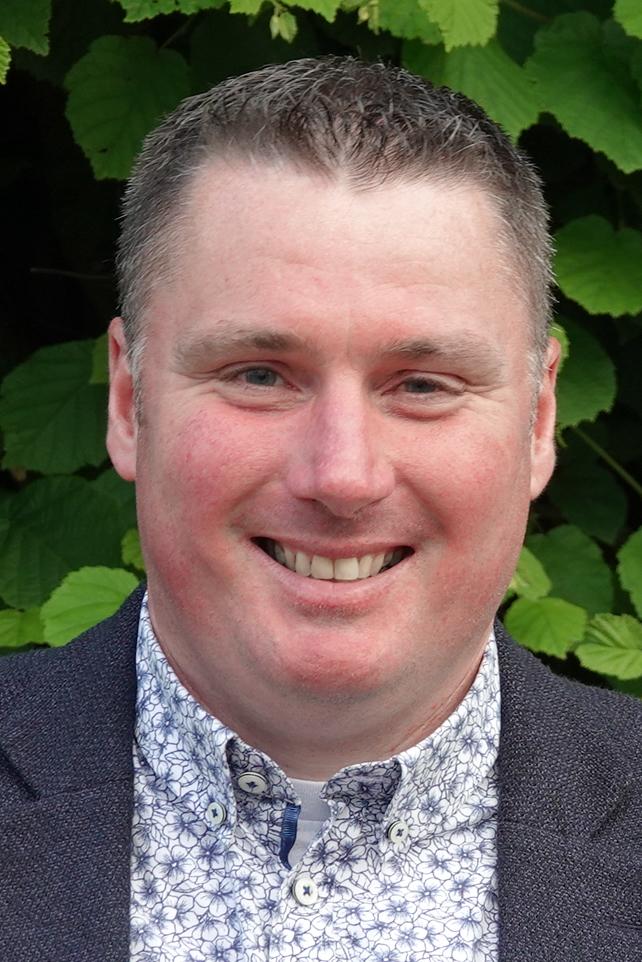
 Faimes, located in the province of Liège, is a rural municipality in the Hesbaye region, made up of the villages of Celles, Borlez, Les Waleffes, Viemme and Aineffe. Since 2024, Jean-Marc Delchambre, a member of the Mouvement Réformateur (MR), has held the position of mayor. His professional career is marked by his role as director of the Aubel municipal abattoir, reflecting his commitment to the local agri-food sector.
Can you tell us about your personal and professional background, particularly your role as director of the Aubel municipal abattoir, and how do you manage, like many other mayors, to combine these two roles which represent more than a full-time job?
The working hours at an abattoir are extremely extensive: from 3am the first colleagues arrive at the abattoir and the last ones regularly finish around 6-7pm, when the loading teams come into action. This extended time range allows me to either be on duty early around 4:30am or arrive late around 12-1pm to work until evening. In addition to working 4/5 for almost 2 years, this shift allows me to be present in the municipality of Faimes almost every day, morning or afternoon, and lets me avoid all the daily traffic jams in Loncin or Cheratte. The Aubel abattoir also has another特点: work takes place every Saturday of the year. This 6-day working organisation in Aubel makes my presence possible in my municipality of Faimes alongside our municipal employees and the population, 2 full days from Monday to Friday.
The days are therefore long, but this is the daily reality for many officials in small municipalities like ours.
You have been a member of the executive since 2006. You have been politically active and involved in your municipality for a number of years. What motivates you to continue to be politically engaged?
I have always been passionate about the municipality: at 12 years old I would go and listen to council meetings, I was part of the youth municipal council of Waremme (I was in secondary school then), I studied political science in Liège, which could prepare us to join local authorities. For me, commitment is called politics, but we actually do very little of it: our ideal must be to serve our citizens, in defence of the general interest. This commitment requires having a vision for the future of our municipality. We are above all a rural municipality, located 5 minutes from the E40 and E42 motorways, in the midst of the small towns of Waremme, Huy and Hannut, 30 minutes from Liège and Namur. The evolution of our society requires having a vision of the municipality we want to leave tomorrow to our children: we can no longer view our villages as in our parents' time, but we must also reflect on what has always constituted the strengths and qualities that residents find in Faimes, in order to try to preserve them despite the necessary changes. I have always campaigned strongly to act in anticipation of problems: some of our actions were sometimes difficult to have accepted, but after almost 20 years in our municipality, there are not many decisions that I regret having contributed to making. Mistakes happen, but deciding means taking risks while trying to see the future as accurately as possible.
Faimes is a rural municipality with a strong agricultural tradition. What do you see as the main challenges facing the municipality today, and what are your priorities for promoting the rural and economic development of Faimes?
Mobility: we are close to everything… by car, given the weakness of public transport. The development of alternative modes of transport is a project we started during the last term and which we will continue. Cohabitation between the rural world and newcomers: Faimes is a municipality with few problems, but we still want to work on further improving this much-needed mutual understanding. The municipality is located in the middle of the economic hubs of Waremme, Villers and Saint-Georges (the closest ones); we would like to see local shops emerge in our villages, and we are indeed part of an ADL whose function is exactly that, but it is difficult given the proximity of towns and other economic hubs.
The municipality of Faimes has a rich heritage, notably with sites such as the Waleffe Saint-Pierre castle. How do you plan to promote and preserve these local characteristics while adapting them to contemporary expectations?
We are even active in this area: Faimes wants its heritage to come alive. The municipality has a small church in Saives on a listed site, which has just been repurposed to house a library. Its installation will take place in the coming months. Our municipality is also undertaking a renovation project for the church of Aineffe, an oratory of which some parts date back to the 11th century and which is listed. This project has been long in the making, as it began several years ago; we will soon have the opportunity to inaugurate a village cultural hall there.
Faimes offers a rich cultural and tourist heritage, notably with sites such as the Waleffe Saint-Pierre castle. What places or cultural events would you recommend to visitors? Are there ongoing initiatives to strengthen the municipality's tourist appeal?
We also have on our territory a magnificent site in Saives, comprising a manor farm and a castle, numerous chapels and wayside shrines. Square farmhouses, churches and many buildings of historical interest. The Waleffe castle, listed as an exceptional monument of Wallonia, is clearly the flagship heritage of our municipality. We organise walks and have set up a small museum dedicated to one of our local authors: Hubert Krains. On that occasion we tried to highlight Faimes' historical heritage. We would like to repeat this kind of event.