
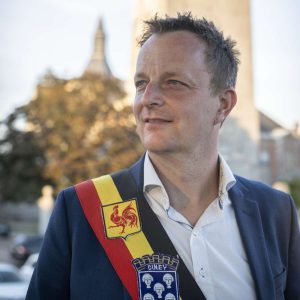
 This week, the Mouvement Réformateur heads to Ciney, in the province of Namur, to meet its mayor, Frédéric DEVILLE. From road safety to facilities for young people, as well as village development, municipal projects touch on many facets of daily life. Through the focus on intergenerational links and the announced development of new leisure infrastructure, a common challenge emerges: supporting Ciney's development while preserving the friendliness and quality of life of its residents.
Frédéric, being mayor means both carrying a vision for your municipality and remaining available for residents' very concrete concerns. What in your journey made you want to get involved for Ciney and take on this responsibility? And how do the liberal convictions that drive you translate into the way you manage the municipality and make everyday choices?
From the age of sixteen, I felt a deep need to get involved for the community, already firmly convinced that it is possible to change things around you. At that age, I took the initiative to set up my village's youth centre. This first adventure was revealing in more ways than one: it allowed me to discover that I truly thrived within teamwork, where collective energy multiplies ideas and gives meaning to actions. I also became aware of my capacity for great creativity, and how much this creative drive carried me day to day when it came to imagining useful and lively projects.
Through these experiences, I developed a real taste for entrepreneurship and the commitment it requires. What particularly appeals to me about entrepreneurship is the freedom to imagine and build a project from A to Z, without being confined to ready-made schemes. I equally enjoy the constant challenge of the field: overcoming obstacles one after another, right when they arise, and being quick to find solutions as the project progresses.
Naturally, in the continuation of this desire to act and build, my choice turned towards local politics. More specifically, the municipal level emerged as an obvious choice, as it remains closest to citizens, their everyday realities and their expectations. It is at this human scale that ideas quickly take shape and that concrete, visible and lasting actions can be implemented in service of those who bring the area to life.
Youth has remained within your portfolio since your first term as alderman and still is today. What is the reason for this interest in the matter? How are the various actions approached?
My very early commitment to young people – first at the level of my village, then as a young alderman within my municipality – allowed me to grasp the realities, expectations and challenges specific to younger generations, but also the scope of possibilities available to local authorities. Over time, one conviction became clear to me: the gap between youth and politics keeps widening, and it is urgent to address it before distrust takes lasting hold. The tensions and unrest seen at demonstrations across Europe, including in our own country, illustrate this feeling of alienation and anger when part of the youth feels it is no longer heard or represented.
Given this observation, acting at the level of children, teenagers and young adults stands out as a democratic and social necessity. It is in this spirit that we have rolled out a set of concrete initiatives to support young people at every stage of their growth and reconnect them to the life of their municipality. Among these achievements, I would like to highlight a few:
- The organisation of free theory lessons to make it easier to obtain the theoretical driving licence, an essential lever for integration and mobility.
- The organisation of a wide range of activities during the “white days” week, right after the end-of-year school exams, to offer young people moments of relaxation, encounter and positive guidance
- The creation of multi-sport grounds in the villages meets a very concrete need: creating places for sport, play and social contact, accessible close to everyone's daily life.
- The creation of a children's municipal council, which gives the youngest a genuine space to come up with and carry projects aimed at improving their municipality, neighbourhood or village
- The door-to-door distribution of the Meuh'gazine vach'ment Kids, a municipal newsletter designed exclusively for children and young people to help them discover, in language and tone they relate to, everything the town offers them
Through all these actions, the goal remains the same: to show young people that local politics is not a distant, abstract sphere, but a living tool close to them, capable of turning their ideas into reality and giving them their full place in the town.
The future is built in the town and in the villages through the opportunities offered to young people but also to older generations. How do you ensure that an intergenerational dynamic takes hold and benefits all residents?
And, beyond these projects, what kind of municipality do you want to pass on to the next generation?
Building a real intergenerational dynamic requires getting different age groups to talk to one another and creating shared spaces where everyone finds their place. In my view, this link goes notably through the children's municipal council already mentioned, but also through the work of the municipal advisory council for seniors (CCCA). Particularly active in Ciney, this council multiplies sporting, cultural and leisure initiatives that foster seniors' wellbeing and broaden social ties.
This desire to bring people together also translates on the ground into structural investments serving everyone. Our sports hall is currently being renovated to double its surface area, providing new spaces for both young and older sports clubs alike.
At the same time, a major complex, unprecedented in Wallonia, is currently under construction and will open next year: it will bring together under one roof a wide range of indoor sporting and recreational activities – laser tag, bowling, an arcade room, indoor golf, padel courts – as well as a sports hall. This complex will be extended by outdoor facilities open to all, such as 3×3 basketball courts, a street workout zone, a pumptrack and a skate park, allowing everyone, from the youngest to the oldest, to move and have fun in their own way.
In every respect, Ciney is undergoing a profound transformation today. The ambition guiding my action is clear: to pass on to future generations a welcoming and friendly municipality, where attention to safety and cleanliness guarantees everyone a pleasant living environment day to day.