
The Government has drawn up a budget that fits within the consolidation trajectory set out in the Government agreement, as it did for its 2025 budget. The trajectory, ambitious given the evolving economic context, is being maintained.
The amount of structural savings achieved will be €270 million for 2026. The effort is significant, but the work continues, constantly seeking to minimise the impact on citizens while continuing to improve public service delivery.
The work for 2026 has moreover already anticipated the thinking needed to best prepare the 2027, 2028 and 2029 budgets.
Some contextual elements
1.1. Federal decision
There is some uncertainty surrounding the budgetary decisions that will be taken at federal level. This is why the Government has intensified its structural efforts, so as to be able to absorb potential impacts.
1.2. Macroeconomic parameters
The macroeconomic parameters used are those from the September 2025 economic budget.
| Budget year | 2025 | 2025 | 2026 |
| initial | Likely | initial | |
| CPI | 1,90% | 2,39% | 1,41% |
| Health index | 2,10% | 2,57% | 1,53% |
| Real GDP growth | 1,30% | 1,17% | 1,15% |
1.3. New European budgetary rules
As a reminder, these rules make the link between spending/revenue, investment/reforms and the debt/deficit reduction target more explicit. They encourage states to maintain sound public finances while preserving essential investments and require sustained consolidation efforts.
The trajectory is maintained
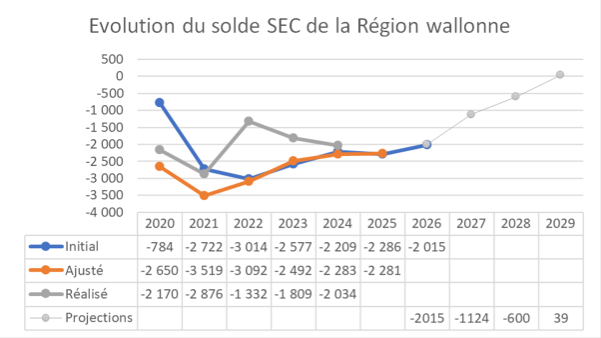
The Walloon Government has made respecting the budgetary trajectory a priority objective. The course set out in the Government agreement is maintained, with an ESA balance of -€2.015 billion.
| (in millions of euros) | 2025 | 2026 | 2027 | 2028 | 2029 |
| ESA trajectory of the Government agreement | -2.363 | -2.015 | -1.124 | -600 | 39 |
| Outcome of the conclave | -2.287 | -2.015 | / | / | / |
Evolution of the ESA balance since 2020 and projection
Structural savings
The objective is indeed to change the way of working by adjusting habits and, above all, to evaluate the results of our public policies. Everyone will need to accept this change and work on proposing new operating methods to increase spending efficiency. The aim is to ensure the greatest possible efficiency in the use of public funds.
| Years | Savings |
| 2025 | 268 million |
| 2026 | 270 million |
| Total | 538 million |
Table of structural savings 2026
| Topics | Subjects | Amount |
| Operations
(€18.1 million) | Cabinets | 0,6 |
| Walloon Parliament | 0,4 | |
| Famiwal | 1,3 | |
| FOREM and IFAPME 1% (continuation of the measure) | 4,8 | |
| Non-indexation of certain public agencies | 4,8 | |
| WBI grant | 0,6 | |
| AVIQ operations | 5,6 | |
| Employment: Training
(€100.2 million) | APE Public authorities indexation freeze (continuation of the measure) | 10 |
| Reduction of the APE envelope, rationalisation of training support, combating double subsidisation... | 83,7 | |
| Pooling of CISP, ALE, MIRE, MDE | 6,5 | |
| Local Authorities
(€65.2 million) | Freeze + 1% Local Authorities (continuation of the measure) | 16,1 |
| Effort by the Provinces | 4,1 | |
| Compensation for Municipalities Marshall Plan | 45 | |
| Health, Elderly, Family
(€28.3 million) | Refocusing of AVIQ's mission | 28,3 |
| Taxation
(€33.6 million) | Gaming and Betting Tax | 8,4 |
| Tax justice | 10 | |
| Water tax on industrial wastewater discharges | 5,8 | |
| Alignment of PKM tariffs | 9,4 | |
| Economy
(€17 million) | Airports | 7 |
| Additional WE dividends | 10 | |
| Discretionary subsidies | 8 | |
| TOTAL | 270,4 |
The major 2026 reforms
4.1. Employment and Training: Work-study, employment aid and hiring bonuses
Refocusing on (re)employment and reform of hiring aid
The Walloon Government continues to refocus its employment policy on sustainable (re)employment, favouring solid jobs over occupational schemes.
The reforms underway continue, and their effects are now very concrete.
Thus, with the entry into force on 1 October of the reform of job-seeker support and monitoring, the Forem is being refocused on its core mission: helping people find jobs. It mobilises job seekers from the moment they register and supports them in a more dynamic and efficient way.
Regarding hiring aid, the overall budget is maintained, but the schemes will be simplified and made conditional to guarantee a real leverage effect. The Government has approved the preliminary draft decree reforming the various employment aid schemes into a single, digitalised mechanism targeting groups furthest from the labour market.
Three entry points are defined:
- Young people (under 25) and seniors (over 57) after 4 months registered with Forem (maximum CESS qualification);
- Jobseekers registered with Forem for 12 months or more;
- Jobseekers registered with Forem for 24 months or more.
Public aid must be a lever, not a windfall. The Region is putting an end to automatic support for commitments that would have been made without it. Beneficiary companies are fully held accountable for fulfilling their part of the agreement.
Resources are also provided for a major reform of local employment actors (ALE, employment centres, CPAS, etc.), in partnership with the Minister responsible for social economy.
In terms of training, the systemic reform of qualifying education and vocational training, in partnership with the Wallonia-Brussels Federation, continues its implementation, and both governments used their respective conclaves to agree on the final elements of this major undertaking, in which the work-study model, notably driven by Ifapme, will be supported, modernised and developed.
4.2. Government permits to simplify and speed up strategic projects
- The list of major investments for which a permit is issued directly by the Government will be extended to major energy transition and territorial redevelopment projects.
- This procedure is already provided for certain motorway, airport and railway projects under Article D.IV.25 of the Territorial Development Code. It avoids a double administrative level and thus considerably reduces procedural steps and timeframes.
This simplified procedure will apply to major energy production and transmission infrastructure, fluid transport infrastructure (CO2 backbone, hydrogen pipeline), the redevelopment of large industrial brownfield sites, and new SOFICO road infrastructure (such as the future RN54).
4.3. Rationalisation of structures
Merger of the Walloon ports
- The four autonomous Walloon river ports will be merged into a single, clearer and more efficient legal structure to make it a European champion (30th port on the continent by tonnage).
- Governance will be centralised, with territorial committees ensuring links with local actors (AdT and private waterway operators).
- The entity, which will take the form of a public-law limited company, will benefit from greater flexibility, better investment coherence and greater commercial autonomy in the service of a shared vision on logistics challenges, freight modal shift and the economic redevelopment of the territory.
Housing Agency
The project to create the Walloon Housing Agency and its local housing hubs aims to make regional housing policy more efficient, in line with the sector's challenges. Its purpose is to provide quality service to all users through a clearer housing landscape, centralisation of tasks and expertise, and optimal use of resources.
Simplification reform of the socio-professional integration landscape
Wallonia has a multitude of socio-professional integration actors (Forem, CPAS, ALE, IDESS, CISP, MIRE, neighbourhood agencies, etc.), making the jobseeker's journey unclear and sometimes redundant.
Through this reform, the local employment ecosystem will be rationalised and simplified by introducing single points of contact.
4.4. Civil service
For a year now, the Government has launched numerous initiatives aimed at modernising the civil service. Throughout this process, it has always been able to count on the commitment of administration officials, whose cooperation was once again decisive during this conclave.
Aware of the tight budgetary framework in which we operate, the Government wanted to give the administration the means to act with clarity and visibility. It thus adopted, among other things, the replacement standard proposal suggested by the SPW itself, allowing each directorate to independently define the most suitable HR dynamics to ensure both continuity, quality and modernisation of public service. This approach empowers all stakeholders and values management close to the realities on the ground.
The replacement standard allows this evolution to be managed by fixing civil service resources at €736 million in 2026, then at €731 million by 2029. This stable and predictable budgetary trajectory gives the administration the visibility needed to plan its actions in the medium and long term, while maintaining the quality of services provided to citizens and confidently continuing reforms.
The Government and all senior civil servants will continue to support this dynamic through the evolution processes already launched, particularly in terms of administrative simplification and continuous improvement of service operations.
SPW Digital, for its part, benefits from a budgetary increase of €14 million compared to the initial 2025 allocation, in order to continue, under better budgetary conditions, the changes essential to the modernisation of the administration.
4.5. Discretionary subsidies, five-year agreements
Sustainability, predictability and simplification of operator funding are at the heart of the discretionary subsidy reform the Government intends to carry out. The objective is clear: to move away from dependence on annual subsidies by providing medium-term visibility through multi-year agreements simplified from their administrative burden. As stated in the guidance note approved by the Government, it is also no longer a matter of granting subsidies case by case but of establishing a clear, transparent and harmonised system.
The Government has approved an €8 million reduction in discretionary subsidies for the 2026 budget. This €8 million comes on top of the €60 million reduction approved in the 2025 budget.
4.6. Forward-looking work
Tax justice
To develop a coherent policy on tax justice and fairness, various approaches are needed. These will sometimes be punitive, sometimes incentive-based, but all contribute to seeking a balanced and fair tax framework. A support structure for policymakers is being set up through an expert committee, notably composed of academic tax specialists. Its task will be to identify ways to improve Walloon taxation, with a view to strengthening tax justice and fairness, and to suggest specific measures implementable in the short, medium or long term. A report will be presented to the Government by 30 September 2026 at the latest.
In parallel with these analyses, the modernisation of regional tax legislation will continue with this aim of tax justice, with the development of a cross-cutting criminal tax framework and the right to error, but also by granting the regional tax administration access to the Central Contact Point of the National Bank of Belgium from 2026, for better recovery of tax debts.
Autonomy guarantee
In a context where nearly one in four Walloons will be over 65 by 2060, and where official demographic projections confirm a sharp rise in those over 80 (IWEPS already indicates 250,000 people aged 80 and over around 2032, and its 2025 outlook highlights the acceleration of the over-80 population after 2030), the Government has decided to take responsibility, and Minister Coppieters' cabinet has been entrusted with leading a group of experts to objectify the situation and propose concrete solutions to the Government as part of an Autonomy Guarantee.
This mechanism will aim to enable people losing autonomy to remain at home while supporting the shift towards outpatient healthcare and our home care system, notably through the initial development of SAFA services for citizens. This group of experts will submit its report to the Government within 6 months.
Family allowances
A group of experts has been tasked with evaluating the family allowance model, under the leadership and coordination of Minister Yves Coppieters' cabinet. This evaluation will, among other things, analyse the impacts of the model introduced in 2019 and produce recommendations for future improvement. A report will be presented to the Government by 30 September 2026 at the latest.
Third cycle of the Spending Review
Four new themes have been defined:
- Priority places for people with disabilities, continuing the previous exercise.
- Public procurement: infrastructure works within public agencies (SOFICO, SPAQuE and SOWAER)
- Postal costs
- Training of civil service staff
Details by area of responsibility
6.1. Adrien Dolimont
Reform of the tariff for gaming and betting taxes
- Taxes on gaming and betting are changing. A single rate of 15% will apply from 1 July 2026, replacing the current complex system of rates ranging from 2.75% to 44%. The only exception concerns automatic entertainment machines (generally “slot machines”) operated in casinos, for which the current progressive rate of 20% to 50% is being replaced by a single rate of 30%.
- This tariff reform, driven by the growth of digital gambling, will generate additional revenue of €8.5 million in 2026 and €22.5 million by 2029.
6.2. François Desquesnes
Reform of “Plan Marshall” compensation to municipalities: a simplified and controlled framework
Launched in 2006, the Plan Marshall compensations were designed to offset the local non-taxation of new business investments (property tax on new equipment, motive power tax and industrial compensation tax). With no time limit, this initially incentivising mechanism generated abuses: increases in municipal tax rates, uncontrolled budgetary growth, windfall effects…
- These compensations will be reframed and simplified by setting strict rules and a time limit. Beyond these clearly defined limits, municipalities will once again be able to levy local taxation if they decide to.
- The budgetary framework will be brought down to €58 million per year in budgetary compensation for municipalities.
Mobility reform: kilometre charge for heavy goods vehicles - aligning the rate with Flanders
- The heavy goods vehicle kilometre charge will rise from €0.13/km to €0.135/km.
- This moderate increase aims to ensure fairness between users and harmonisation with neighbouring regions, particularly Flanders.
- The kilometre charge will generate more than €20 million per year, collected by SOFICO, two-thirds of which will come from foreign hauliers.
Regional funding of municipal investments: simplification and support
- FERI will replace FRIC (the Regional Fund for Municipal Investments), with the aim of offering municipalities a radical simplification in the use of allocated funds. Paid under the extraordinary budget, the FERI grant will be able to finance all investments without heavy, lengthy procedures. The mechanism will apply to the 243 towns and municipalities of Wallonia.
- For the 9 major cities (over 50,000 inhabitants), a specific grant of €35 million will be created to consolidate and simplify several existing sources (major cities policy, share of the former FRIC, and Namur-capital subsidy).
- The administration's role will be completely revised: from a supervisory and control role to a mission of support and advice within a partnership approach. An audit control will also be introduced.
Emergency services zones: strengthened territorial solidarity
From 2026, the provinces will gradually take over the funding of emergency services zones, reaching 100% by 2030.
- This measure will durably ease municipal budgets. In 2026, at indexed spending levels, this represents a 15% reduction in municipal contributions to emergency services zones.
- This measure reflects the intention to focus provincial action on serving municipalities, their territory and their residents, within a supra-municipal approach.
Strengthening road safety: adapting Walloon legislation to allow municipalities to enforce speed control on their municipal road network
- A decree-based framework will allow municipalities to enforce speed control on their municipal road network and collect fines for speeding offences.
- The system will be voluntary: each municipality or police zone will decide on its activation.
- The fines collected will allow municipalities to free up budgetary resources under the extraordinary budget to fund investments in securing the municipal road network for pedestrians, cyclists and motorists.
6.3. Pierre-Yves Jeholet
Employment and training
Budgetary target: €83.7 million in 2026:
- APE reduction, RW public bodies (25%) = €2.82 M
- APE reduction, WBF public bodies (25%) = €0.79 M
- APE reduction, RCA (25%) = €0.73 M
- Abolition of APE for police zones = €0.51 M
- Abolition of APE for emergency services zones = €0.56 M
- Abolition of APE for provinces = €7.32 M
- 12.5% reduction in APE for profit-making non-profits (ISOC) = €2.50 M
- 12.5% reduction in APE for intermunicipal associations = €4.77 M
- APE reduction for towns and municipalities = €17.50 M
- Recovery of overpaid APE amounts = €15 M
- Ending windfall effects and streamlining training schemes = €20 M
- Tackling double subsidisation in TS = €6 M
- 50% reduction in the indexation of the regional TS subsidy = €5.18 M
Other key measures
In addition, the Government has decided to launch a targeted reform of the Socio-Professional Integration Centres (CISP) sector, aimed at greater accountability and efficiency. This mechanism, essential to jobseekers' reintegration pathways, must now better demonstrate its impact and efficiency on jobseekers' journeys. Recent findings have highlighted significant disparities between operators, low or even nil integration rates in certain sectors, as well as a tendency towards automatic renewal of accreditations. The Government's aim is therefore to redirect resources towards actions that have a concrete effect on employment.
- Finally, the resources allocated to the MIREs will be increased for 2026, pending a reform of the scheme.
- In addition, the local-service jobs ecosystem will be streamlined and simplified for the benefit of jobseekers. Wallonia indeed has a multitude of socio-professional integration actors (Forem, CPAS, local employment agencies, IDESS, CISP, MIREs, neighbourhood agencies, etc.), which makes jobseekers' path hard to follow and sometimes redundant.
Economy and dividend
- Wallonie Entreprendre: a €60 million reduction in credits (from €124 million to €64 million) in line with WE's roadmap, which aims for full self-financing in the long term, and a €15 million increase in WE's dividend to the Region (from €55 million to €70 million).
New policy
In addition to the reform of hiring aid, whose budget is maintained, €23 million will be reallocated to the mainstream or social economy sector, as part of the reform of the local-service jobs ecosystem.
This budget will in particular fund a reform of the local employment agency (ALE) and IDESS schemes and create a single scheme built around the simplification reform of the socio-professional integration landscape and the creation of single points of contact.
The reform aims to simplify and streamline this landscape by introducing single points of contact, which will offer:
- Shared reception and a clearer employment pathway for jobseekers furthest from the labour market;
- Strengthened coordination between Forem, the CPAS and local employment actors;
- Comprehensive, coherent support close to home, with a gradual pathway towards employment depending on employability level;
- A diversified offer: remotivation, work placements, qualifying training, reintegration through work.
6.4. Yves Coppieters
Health
Certain child benefit arrangements are being optimised to make them fairer and clearer. The right to benefits for 18-25 year-olds will now be harmonised and made conditional on an active status (studies, training or an integration project) from 1 September of the year they turn 18 (effective from 2027). A “12-month pot” will be introduced allowing young people aged 18-21 to retain their entitlements after finishing their studies or training, to be used all at once or as needed.
- Procedures will be simplified through the digitalisation of exchanges on school enrolments between higher education institutions and family benefit funds.
- At the same time, the income threshold for single-parent families will be raised to €54,867 gross/year for children born from 1 January 2020, enabling more families to access the increased supplement.
- Finally, for children with disabilities, payment of the supplementary family allowance (AFS) will be suspended when the young person receives a federal allowance (ARR or AI), while guaranteeing the most favourable amount for the family. In addition, the public fund FAMIWAL is contributing €1.3 million to this effort.
The Agency for a Quality Life (AVIQ)
AVIQ is contributing to the collective effort to control Walloon public spending and is part of a reform process, through more efficient management of its resources and a refocusing on its core missions, for the benefit of citizens and operators.
Specifically, the agency's management grant will not be indexed in 2026, and the regional replacement rate for retirements will be applied, while preserving recruitment flexibility for critical roles. Resources for core activities will be preserved, duplication eliminated, consistency between health and social policy strengthened, and under-execution corrected.
The saving on the management grant amounts to €5.6 million, and the refocusing of missions to €28.3 million.
Solidarity
- A structural envelope of €10 million from existing and available credits is being reallocated to the Solidarity portfolio to strengthen homelessness prevention, the fight against poverty and support for single-parent families.
- These resources will directly fund frontline services, particularly health relays, intermunicipal social relays and new anti-poverty actions, so as to better meet the needs of the most vulnerable groups by acting simultaneously on living conditions, access to healthcare and social integration, in order to prevent breaks in life pathways and foster lasting inclusion.
Environment
- Wallonia is revising the tax on industrial wastewater discharge in order to strengthen the true-cost principle for water treatment and fund the transition towards sustainable water resource management.
- This reform will ensure compliance with the European Water Framework Directive, correct an imbalance between households and industry regarding treatment costs, and reinvest the new revenue in pollution clean-up and the protection of water catchment areas.
- The revenue will notably fund water treatment and the implementation of the new “Urban Wastewater” directive. Additional regional revenue is estimated at nearly €6 million in 2026.
6.5. Jacqueline Galant
- An administration that continues to modernise and simplify while better regulating its recruitment. In 2026, the budget allocated to the SPW will be capped at €736 million. This effort will be implemented via a budgetary recruitment (replacement) norm, as proposed by the administration. Not all departures will therefore be replaced.
- In line with the DPR, senior managers are being given greater accountability and enjoy full operational management autonomy for decisions within the budgetary framework set by the Government.
- The resources allocated to SPW Digital are being increased.
6.6. Valérie Lescrenier
Childcare: a confirmed and reinforced commitment
The goal of creating more than 5,000 places is maintained, through the existing Équilibre plan and the preparation of a new plan.
- Increased resources to ensure the construction of nurseries under the next plan (+€4 million)
- An initial additional budget has been released to ensure the operation of ongoing projects (+€6 million).
- A clear priority: supporting families and guaranteeing early childhood care.
Tourism and Heritage
The Walloon Government wants to strengthen the coherence of the missions entrusted to the various tourism bodies. This approach aims to clarify each actor's role in order to provide visitors with more structured and accessible information.
6.6. Cécile Neven
- The provisions of the DPR relating to airport governance will be implemented. A structural saving of €7 million will take effect from 2026. The grants to management companies, covered by agreements, will be negotiated between shareholders to provide for a phasing-out over the 2027-2029 period. The current model must evolve to reduce its dependence on direct aid from the Region.
- The Government is honouring its commitments: the funds needed to finance the stock of energy renovation grants are secured in 2026.
- An external audit of the SWCS, the SWL and the FLW will be carried out. The findings of this audit will enable the Government to gain an objective overview of the situation and needs, and to inform ongoing work on the establishment of the Housing Agency.
- In line with the decision taken during the 2024 budget adjustment, the funds needed to refinance the SWCS are provided for in 2026.
- Major energy infrastructure will henceforth be recognised as strategic infrastructure, subject to a government permit. The procedures for this will be revised to speed up timeframes.
6.7. Anne-Catherine Dalcq
- Strengthening and stabilising biodiversity actions. To this end, €5,540,000 will now be entered in the budget on a recurring annual basis. For the Department of Nature and Forests (DNF), these resources will notably help reinforce its actions. They will give outdoor service directorates the ability to make investments in state forests, restore and create habitats, ensure the maintenance and renovation of state forests and reserves, and support the management and prevention of fires in natural environments. Part of these resources will also be devoted to combating invasive species and to certain associations whose missions will be refocused.
- A thorough reform has been carried out so that every euro spent is genuinely used where it is truly needed, in relation to discretionary subsidies for agriculture and nature. This work, begun in early 2025, has now been completed. It was based on a rigorous method, carried out in close collaboration with the administration, aimed at identifying overlaps, assessing the real effectiveness of actions and measuring results using objective indicators. On the basis of this work, from 2026 associations will benefit from lasting funding, guaranteeing a clear and stable multi-year outlook. In terms of nature, priority will be given to habitat restoration and to supporting and strengthening biodiversity in our forests, countryside, towns and villages. This marks the end of piecemeal support: from now on, the rules are clear, fair and focused on the effectiveness of action on the ground.
Summary table
| Budget balances (EUR million) | 2025 Initial | 2026 Initial | Delta Ini 26 - Ini 25 |
| (1) REVENUE | 19.124 | 18.507 | -617 |
| (2) EXPENDITURE | 22.029 | 21.327 | -702 |
| (3) GROSS BALANCE TO BE FINANCED = (1)-(2) | -2.905 | -2.820 | 85 |
| (4) ESA CORRECTIONS | 619 | 805 | 186 |
| (5) ESA BALANCE = (3) + (4) | -2.286 | -2.015 | 271 |